
Every battery storage datasheet carries a capacity in kWh and a power rating in kW. Both numbers are real, both were measured, and neither is unconditional. Each one was measured at a temperature, and on a site where the afternoon ambient sits well above the temperature the test used, the number that arrives on site is not the number that was quoted.
The gap is not a defect in the product. It is a property of the chemistry, and it is predictable. What is less predictable is how large the gap will be at a specific site, because it depends on the enclosure’s thermal design, the duty cycle, and the position of each cell inside the container. This article works through what heat does to a battery system, why the effect is larger than a single derating figure suggests, and what to establish before accepting a capacity or cycle-life claim.

The Number on the Datasheet Has a Temperature Attached
Capacity and power ratings for lithium-ion storage are not constants. They are the output of a test, and every test has conditions attached: the temperature at which it ran, the rate of charge and discharge, and the voltage window it ran between. The convention across the industry is to quote at a cell temperature near 25°C, at a defined rate, across a defined state-of-charge window.
None of this is concealed. It is in the test standard and usually in the datasheet footnotes. The difficulty is that a footnote is easy to read past, and a specification that compares two products on their headline kWh figure is comparing two numbers measured under conditions neither product will see in service.
A system on a site with 45°C afternoon ambient does not operate at 25°C. Depending on the enclosure and the cooling arrangement, cell temperature may sit well above ambient during sustained operation, because the cells generate heat themselves while charging and discharging. So the question that matters is not what the ambient temperature is. It is what the cell temperature will be under the duty cycle the project actually runs — and those two numbers can be far apart.
This is where the two ratings start to behave differently as well. Capacity and power respond to temperature in different ways and at different rates, which is why a selection made on both ratings separately holds up better in a hot climate than one made on capacity alone. A system can have ample energy in reserve and still be unable to deliver it at the rate the load demands, and heat widens that gap rather than narrowing it.
Three Things Heat Does at Once
Heat affects a battery system through three distinct mechanisms, and they compound.
The first is a reduction in what the system can deliver while it is hot. A cell at elevated temperature holds less accessible energy on a given discharge and accepts less charge, than the same cell when cool. This effect is largely reversible — the energy is not gone, it is less accessible for the duration — but it is real, and it is present exactly when demand tends to peak.
The second is not reversible. Elevated temperature accelerates the side reactions inside a cell that consume active material and thicken the passivating layers on the electrodes. The rule of thumb from reaction kinetics is that a chemical process roughly doubles in rate for every 10°C increase in temperature. Battery ageing is not a single reaction and does not follow that rule precisely, but the direction is not in question and the effect is substantial. A system that runs hot ages faster in calendar terms even when it is barely cycled, which is why a standby application with low throughput is not automatically a mild duty.
The third is a control response rather than a physical one. A battery management system protects the cells it is responsible for. When temperature or current moves beyond what it considers safe, it reduces charge or discharge power, or stops the operation entirely. From outside the enclosure this presents as a system with less power than its nameplate — because during the hottest part of the day, it is.
The three arrive together. A hot afternoon lowers what the system can deliver, accelerates the ageing that will lower it further next year, and may trigger a limit that removes capacity for the duration. Designing against any one of them in isolation underestimates the site.
Why Temperature Is Not Uniform Inside a Container
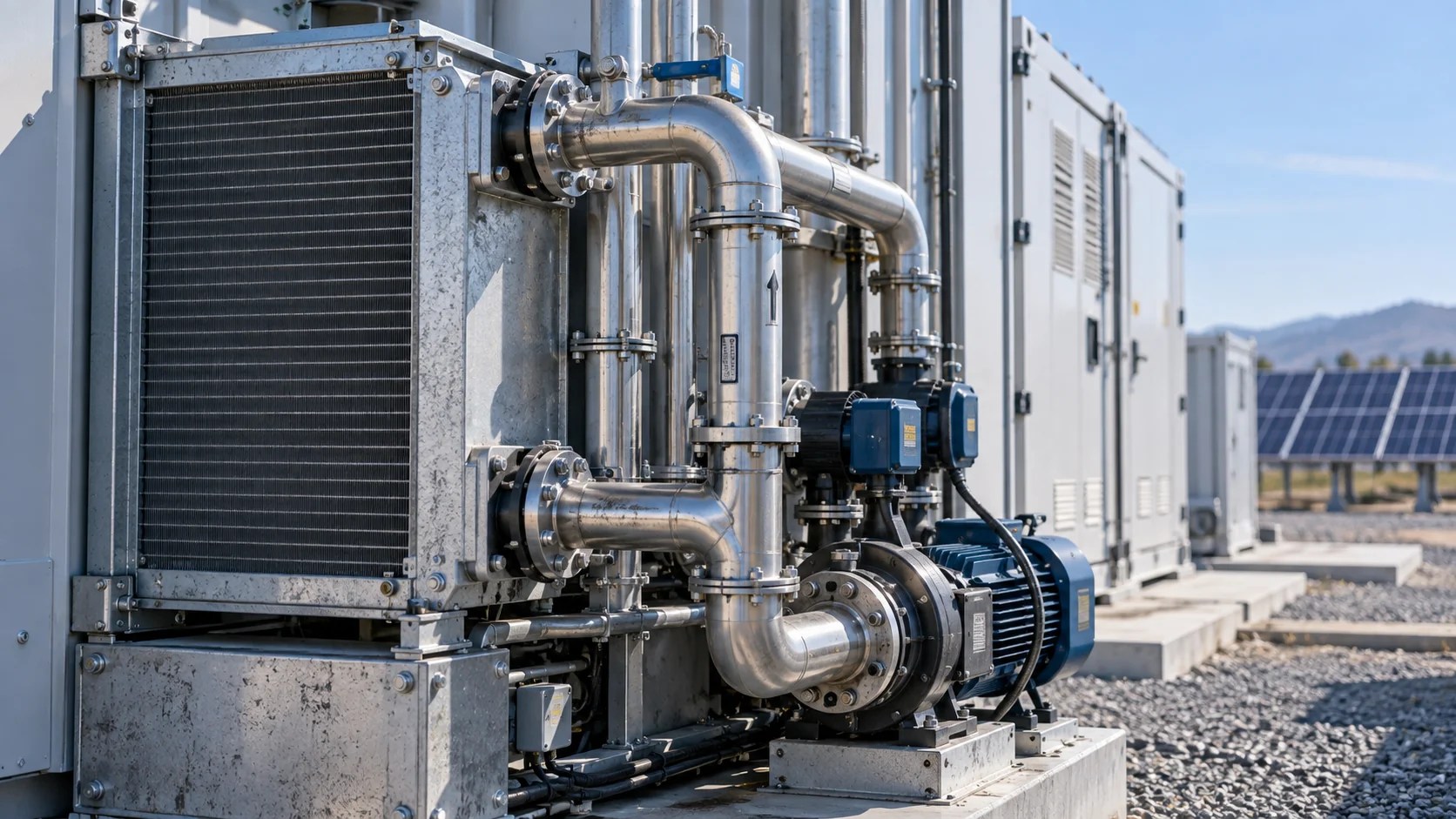
Cells inside a containerised system are not all at the same temperature. Racks near a cooling inlet run cooler than racks in the middle or near the exhaust, and air-cooled designs can show a meaningful spread across a single container under load. Liquid-cooled designs generally hold a tighter spread, which is one of the reasons the two approaches diverge in hot climates rather than converging.
The spread matters more than its size suggests, for two reasons.
The first is that a battery string is limited by its weakest cell. Charging stops when the first cell reaches its upper voltage limit; discharging stops when the first cell reaches its lower limit. If one cell runs hotter than its neighbours, ages faster, and drifts out of step with them, the whole string progressively loses usable capacity to that one cell. This form of loss never appears in a per-cell test and does not show up in a capacity check performed at commissioning.
The second is that the battery management system acts on the hottest measurement it can see. A container with a wide temperature spread will reach its protection thresholds earlier than a container with a narrow one, even when the two have the same average temperature. Temperature uniformity, not average temperature, is what determines how much of the nameplate a system can actually use on a hot day.
That is also why enclosure design in hot climates is a different problem from enclosure design in temperate ones — and part of a wider set of choices about how equipment is protected from its surroundings, which is the subject of how IP ratings and corrosion classes translate into site conditions. Temperature and environment are separate problems, but they are solved in the same enclosure.

Air Cooling and Liquid Cooling: What the Choice Actually Buys
In moderate climates, the choice between air cooling and liquid cooling for a battery container is often made on cost and maintenance. In hot climates the same choice changes character. The cooling system is no longer managing a mild deviation from a comfortable temperature; it becomes the component that decides how much of the system’s capacity is available on the hottest days of the year.
Air cooling moves heat from the cells into the air and then out of the enclosure. Its effectiveness depends on the temperature of the air it has to work with, which on a hot site is already high, and on the path that air takes through the racks. Liquid cooling transfers heat into a fluid circulated to a chiller or heat exchanger, which decouples cell temperature from ambient temperature to a much greater degree.
The differences show up in three places: how tightly the cell temperature spread is held, how much power the thermal management system itself consumes, and how the system behaves when ambient temperature peaks.
The second of those is easy to overlook. Cooling is a parasitic load. Every kilowatt-hour the thermal management system consumes is a kilowatt-hour the site does not receive, and in a hot climate that load is present at exactly the time the system is working hardest. Round-trip efficiency measured under mild test conditions does not describe a hot-climate duty cycle, because it does not include the cooling load that climate creates.
The third is a matter of margin. A cooling system sized for average conditions will hold cell temperature acceptably for most of the year and fall short during the hottest weeks. What the site experiences during those weeks is not a gradual decline but a system that reaches its limits and stays there until the weather changes.
Specifying for a Design Ambient
The common way to handle heat in a specification is to add a margin at the end: size on nameplate values, then increase capacity by some percentage to cover losses. This treats temperature as an uncertainty to be absorbed rather than a design input to be defined, and it tends to produce a system that is either oversized in a way nobody can justify or undersized in a way that only becomes visible in the second year.
The alternative is to fix a design ambient temperature at the start — the temperature the system is expected to operate at during its most demanding conditions, not the annual average — and then require that continuous and peak capability be stated at that temperature. Solar arrays and inverters are already specified this way in good practice, using site temperature extremes to set the voltage window. The same logic applies to storage, where it is less consistently applied.
Establishing that number requires two things about the site: the ambient temperature it reaches, and the duty cycle the system will run. A storage system that charges and discharges once a day has a different thermal profile from one that cycles several times, and one that discharges at high power for a short period differs again. The duty cycle is what converts ambient temperature into cell temperature, and it is the part most often left out of a specification.
Once the design ambient is fixed, the equipment conversation becomes concrete: what the system delivers at that temperature, what the thermal management system consumes while delivering it, and what the resulting round-trip efficiency is under the duty cycle the site will actually run. The published ranges for battery energy storage are the starting point for that conversation, not the conclusion of it.
What to Ask Before Accepting a Capacity or Cycle-Life Claim
A capacity warranty and a cycle-life figure are only meaningful together with the conditions they were measured under. Four questions cover most of the ground.
At what temperature? A cycle-life figure measured at 25°C describes a system that will not operate at 25°C for much of the year on a hot site. The relevant figure is the one measured at, or corrected to, the design ambient.
Across what state-of-charge window? A narrow window is gentler on the cells than a full charge and discharge, and it also delivers less energy per cycle. A cycle count without the window attached cannot be compared with another cycle count.
At what charge and discharge rate? Rate affects both heating and ageing. A figure measured at a low rate describes a duty the project may never run.
What happens outside those conditions? Warranties typically define operating envelopes, and behaviour beyond them is where disputes begin. The useful question is not whether the envelope exists — it will — but whether it matches the site.
Getting these answers before the order is placed changes what can be negotiated. Getting them afterwards changes only who carries the risk.
The practical starting point is a description of the site rather than a selection of equipment: the ambient temperature it reaches, the load it has to carry, and how that load falls across the day. Send those three things and the engineering team can establish whether storage is the right answer for the site at all, and what its capability would be at the temperatures the site actually reaches. The system architecture that follows from that is set out in solar-battery-diesel hybrid microgrids, and the same reasoning applied to a specific industry in mining microgrids, where high ambient temperatures and continuous load often coincide.
FAQ
Q: Our site reaches 45°C in summer. Does that mean battery storage will not work there?
A: It means the storage has to be specified for that temperature rather than for a nameplate figure measured at 25°C. Storage operates in high-ambient locations routinely; what changes is how much capacity and power are available during the hottest part of the day, how much the thermal management system consumes, and how the system is expected to age. A design that accounts for those three things is a normal engineering exercise. A design that ignores them produces a system that underperforms in its first hot season, which is the more common outcome.
Q: The datasheet quotes a capacity. Is that number wrong?
A: No. It is a measurement with conditions attached, which is standard practice and is usually stated in the footnotes. The number is accurate for the conditions it was measured under. The question to ask is not whether it is true but whether those conditions resemble the site — and if they do not, what the equivalent figure is at the temperature the site will see.
Q: Is liquid cooling necessary in hot climates, or is it a preference?
A: It is a trade-off rather than a rule. Liquid cooling generally holds a tighter cell temperature spread and decouples cell temperature from ambient more effectively, at higher cost and with more components to maintain. Air cooling is cheaper and simpler, and in a hot climate it works harder and holds a wider spread while doing so. Which one is appropriate depends on the duty cycle, the ambient profile, and how much capacity the project needs available on its worst days. It is worth deciding on those grounds rather than on capital cost alone.
Q: How do we know what cell temperature our system will actually run at?
A: It follows from the ambient profile and the duty cycle, but it is not something a site owner can calculate from a datasheet. It depends on the enclosure, the cooling design, the rack layout, and how hard the system is worked. In practice it is established during design, based on the site’s temperature profile and the intended operating pattern, and then confirmed once the system is running, since monitoring data shows what the cells actually experienced rather than what was assumed.
Q: Our site is hot but the load is not continuous. Does that change anything?
A: It changes the thermal profile considerably, and usually in the project’s favour. A system that runs hard for a few hours and then rests has time to shed heat between cycles, so its cells spend less time at high temperature than a system under continuous cycling. What matters is whether the demanding periods coincide with the hottest hours of the day, which is common for afternoon-peaking loads and worth checking rather than assuming.
Q: What happens to the warranty if the system runs above the temperature it was tested at?
A: Warranties typically define an operating envelope, and performance outside it is handled by the terms of that envelope rather than by the headline figure. This is why the test conditions behind a capacity or cycle-life claim matter as much as the claim itself. If the envelope matches the site, there is no issue. If it does not, the mismatch is worth resolving before the order rather than after the first summer.
Q: What do you need from us to assess storage for a hot site?
A: Three things: the ambient temperature profile the site reaches, the load it has to carry and how that load varies across the day, and the current power source and its limitations. From those, an architecture and a capacity range can be established, and the equipment that follows from them can be checked against the design ambient rather than against a nameplate. Starting from a product list inverts the order and tends to produce a system that meets a specification without meeting the site.
YURI POWER Engineering Team · October 5, 2026