APPLICATION
Containerized Hybrid Power Station
Pre-engineered, factory-tested containerized power solutions ready for plug-and-play deployment anywhere in the world.

APPLICATION
Pre-engineered, factory-tested containerized power solutions ready for plug-and-play deployment anywhere in the world.
A complete power plant in a standard ISO shipping container. Each unit includes diesel generators, solar inverters, battery storage, switchgear, and SCADA control — all pre-wired, factory-tested, and ready for site connection and commissioning upon delivery.
Ideal for remote mining sites, island microgrids, construction camps, military bases, and disaster relief operations.
| Container Sizes | 10ft, 20ft, 40ft (standard & high cube) |
| Power Output | 50kW – 2MW per container |
| Battery Capacity | 100kWh – 5MWh |
| Solar Integration | Up to 1MWp |
| Generator | 50kVA-2000kVA diesel/gas |
| Cooling | Forced air + HVAC option |
| Noise Level | <75dB at 7m |
| Deployment Time | Plug & play in <4 hours |
| Compliance | Applicable documentation checked by destination country, model and configuration |
Operation
Deployment
Install Time
Shipping
Tell us your power requirements. We design, build, and ship worldwide.

A containerized hybrid power station is a complete solar-battery-diesel power system pre-engineered, factory-built, and tested inside a standard ISO 20ft or 40ft shipping container. It arrives on site ready to connect. The site prep work is reduced to a concrete pad and cable landing.
This approach transforms project timelines. A traditional power plant takes 12-18 months from order to commissioning. A containerized system ships in 8-12 weeks and commissions in 2-4 weeks. Total project time: 3-4 months. How the system underneath is arranged, from the array to the point of connection, is described in solar, battery and diesel hybrid microgrid design.
The storage module options are set out on the battery energy storage page.
Pre-commissioned at factory. On-site work is just cable connection. Commissioning in days, not months.
Standard ISO dimensions. Ships by sea, road, or rail. No oversize permits. Corner castings for any handling equipment.
Insulated walls + HVAC protect batteries and electronics from -30°C to +55°C ambient.
Start with one container. Add more as load grows. Parallel up to 10 units. No design change needed.
End of mine? End of construction project? Pick up and move to the next site. Capital cost is preserved.
Containerisation solves a site problem, not an equipment problem. These are the conditions where it earns its place — and the one where it may not.
| If this describes your site | What it means |
|---|---|
| The site is reached by sea, barge or a long road | Factory build and standard ISO dimensions remove most of the fabrication that would otherwise happen on site |
| The load grows in phases over several years | Additional units can be added and paralleled without redesigning the system |
| The power is needed for a defined project period | The asset can be relocated when the project ends, so the capital is not stranded |
| Skilled electrical labour is scarce locally | The system is pre-commissioned at the factory; site work is connection and testing |
| The site is in an extreme climate | The enclosure carries its own thermal management, so the equipment inside sees a controlled environment |
| There is a permanent plant room with space and local contractors | A stick-built arrangement may be the better fit — the container’s advantages are mostly about the site, not the equipment |
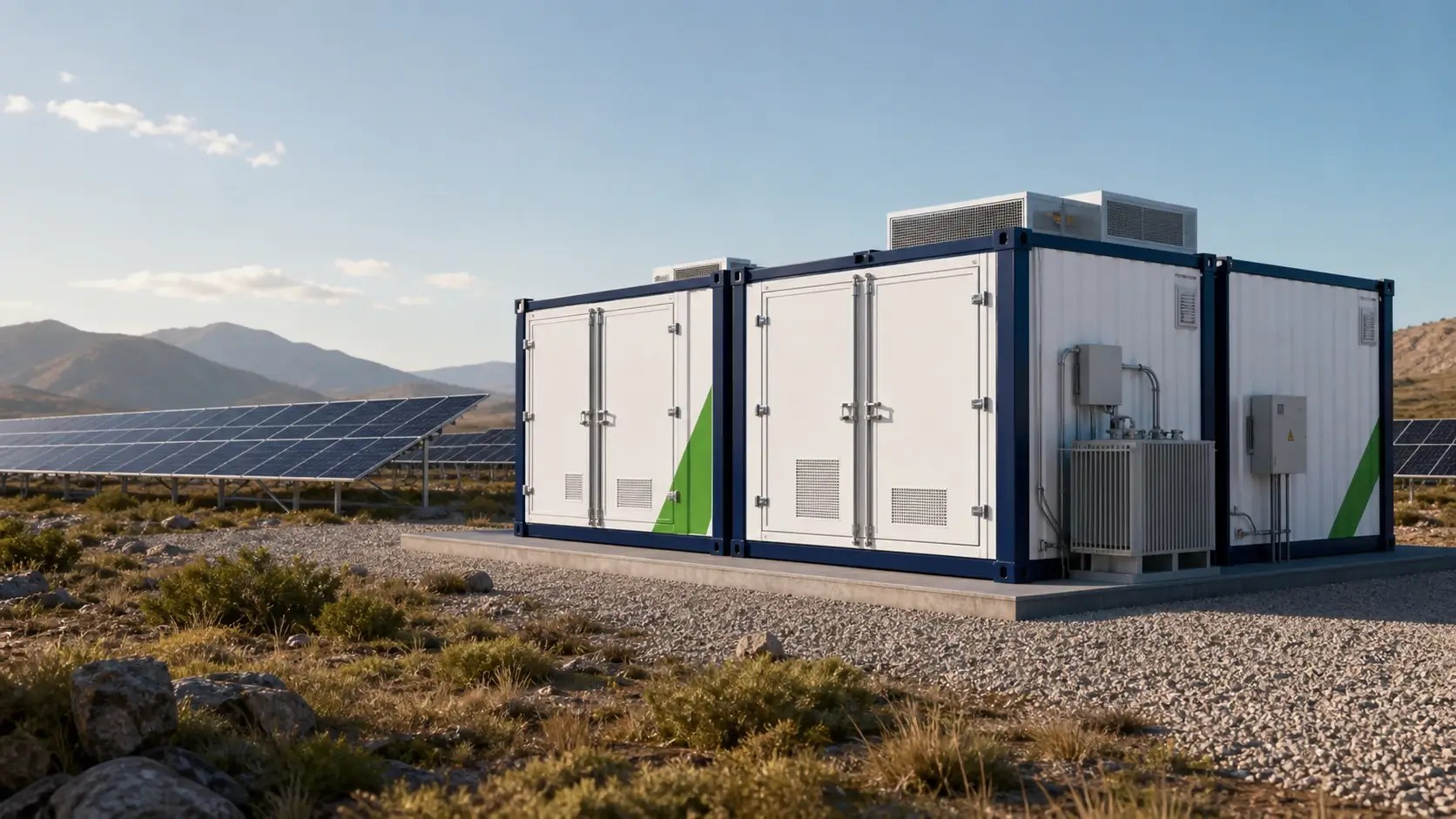
Containerized hybrid power stations are deployed worldwide in:
Containerized systems have compelling economics across the full lifecycle:
Two quotes for the same container rarely cover the same scope. What to compare before the price is set out in commercial BESS quote comparison.

While we have standard reference designs, almost every project requires some customization. Common customizations include:
Our engineering team works with you to specify exactly what your project needs, then builds to that specification. No two projects are identical—but the underlying platform is proven across 500+ installations.
A pre-assembled 20 or 40 ft container integrating PV input, storage, hybrid inverter, switchgear and controls. Plug-and-play.
Under 24 hours on a prepared pad after delivery. Each unit is factory-tested and pre-commissioned before shipment.
Scale from about 100 kW to several MW by paralleling containers. Storage and PV are sized to your duty cycle.
Remote communities, mining camps, islands, construction sites and events that need reliable power without grid build-out.