APPLICATION
Telecom Tower Power
Reliable off-grid and hybrid power solutions for telecom towers, data centers, and communication infrastructure.

APPLICATION
Reliable off-grid and hybrid power solutions for telecom towers, data centers, and communication infrastructure.
Telecom towers require power throughout the day and night. Our hybrid solutions combine solar PV, battery storage and diesel backup. Availability targets, fuel use and maintenance requirements are assessed for the specific tower load, site conditions and operating strategy.
Designed for remote locations with limited access — our systems are containerized, pre-wired, and require minimal on-site work.
| Power Output | 3kW – 50kW per site |
| Battery Bank | 20kWh – 400kWh |
| Solar Array | 5kWp – 100kWp |
| Diesel Backup | Auto-start, auto-transfer |
| Rectifier | 48V DC, 95%+ efficiency |
| Enclosure | IP55 outdoor rated |
| Monitoring | SNMP + remote SCADA |
| Uptime SLA | Project-specific |
Uptime
Fuel Cost
Towers
Deploy
Telecom towers need a contracted availability figure — anything less triggers SLA penalties that can dwarf the cost of power itself. The challenge: most towers are in remote or off-grid locations where reliable power is hard to find and expensive to maintain.
A hybrid solar-battery-diesel system delivers grid-equivalent reliability at off-grid cost. The economics work at almost any scale, from a single tower to a 50,000-site nationwide rollout. The reasons operators are moving in this direction, and the site conditions that drive it, are set out in why telecom towers are switching to hybrid solar power.
SLA uptime achievable
Diesel reduction
Typical payback
Site visits
Typical greenfield 4G/5G macro tower. Components:
5G small cells, multi-tenant towers, edge compute:
Standardized design for fast deployment:

The traditional diesel-only tower has three problems: cost, reliability, and reputation. Hybrid solves all three. What it takes to keep a base station online, described from the site side, is covered in telecom tower uptime on solar, battery and diesel.
For an off-grid tower, the comparison starts with its diesel consumption, delivered fuel price and maintenance visit costs. Solar and storage may reduce generator runtime and fuel logistics; savings and visit frequency require a site-specific load and operating assessment.
SLA compliance is assessed against the site load, system configuration and the availability targets agreed in the contract. Downtime exposure and any applicable penalties require project-specific assessment; no universal downtime or penalty savings are assumed.
Telcos face increasing Scope 3 emissions reporting pressure. Hybrid towers reduce CO₂ per site by 60-80 tons/year. Many operators now require 50% renewable energy at towers as procurement policy.
Two towers with the same load can need different systems. These are the inputs that move the design most — and the reason a quotation built only from a kW figure is not yet a design.
| What to know about the site | Why it changes the design |
|---|---|
| Grid availability at the site | A site with an unreliable grid needs a different design from a true off-grid site, even when the diesel consumption looks the same |
| Diesel delivery frequency and road access | The harder the site is to reach, the more each hour of generator running costs — which is what makes storage worth its price |
| The autonomy the SLA actually requires | Backup duration is a contractual number, not an engineering preference; it sets the battery more than any other input |
| Load growth from a 4G to a 5G upgrade | A tower sized for today’s load and then upgraded usually costs more than one designed for the upgrade from the start |
| Access for installation and maintenance | Weight, lifting and enclosure size are decided by how the equipment reaches the site, not by the equipment itself |
| How many sites, and how they are managed | A single tower and a national rollout are different procurement problems: one is a project, the other is a programme |
How these inputs become an arrangement of equipment is described in solar, battery and diesel hybrid microgrid design.
Beyond standard greenfield towers, our hybrid systems handle several special scenarios:
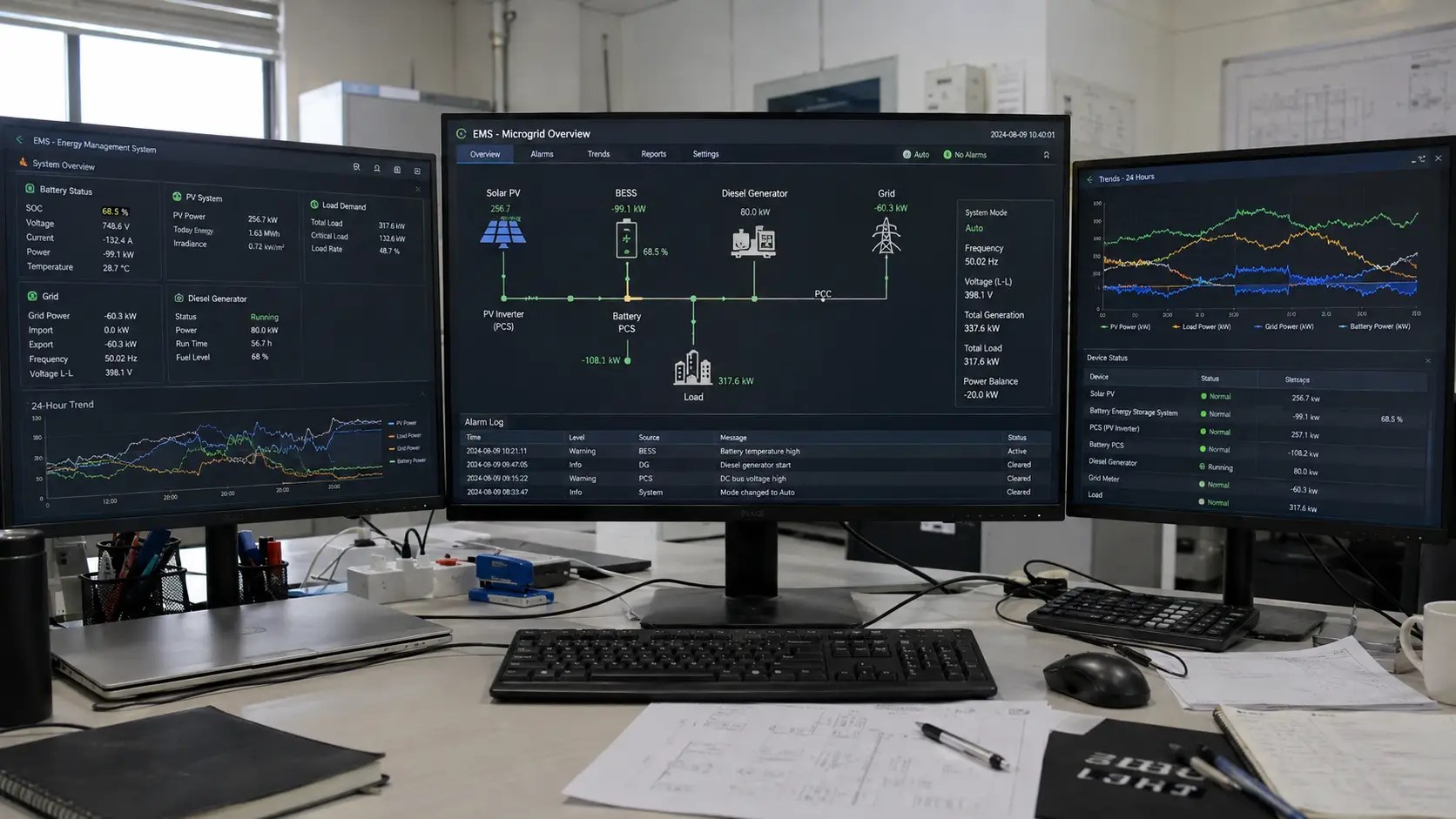
All our telecom hybrid systems include cloud-based monitoring as standard. Your NOC or operations team gets real-time visibility into every site:
The monitoring and control hardware behind this is described on the energy management system page.
The platform supports both individual site management and bulk operations across thousands of sites. Multi-tenant access allows operators, EPCs, and O&M contractors to each see the data they need.