
A base station that goes dark is not a billing problem. It is a coverage hole, a question from the regulator, and a credit under the site’s service level agreement – and in plenty of markets it is also the moment a village loses its only connection.
That is the constraint the power system has to be designed around. Yet most base station power decisions start somewhere else entirely: with the diesel bill. The fuel invoice is the number that arrives every month, the number that appears in an opex line, and the number that a hybrid proposal is usually sold against. It is real, and it matters. It is also not the number that decides whether the site stays on air.
The distinction is not academic. A tower company whose network was measured at 83% availability against a 99.80% target, with only about one site in eight carrying a fixed generator and a similar share carrying backup batteries, was not short of fuel. It was short of power that could be relied on – and a large part of the shortfall came from faults that no fuel contract can prevent.
This article sets out what a base station actually draws, why diesel sites keep their generators running for most of the day, what uptime really costs and what breaks it, and how solar, battery storage and diesel divide the job between them when the design starts from availability rather than from the price of a litre.
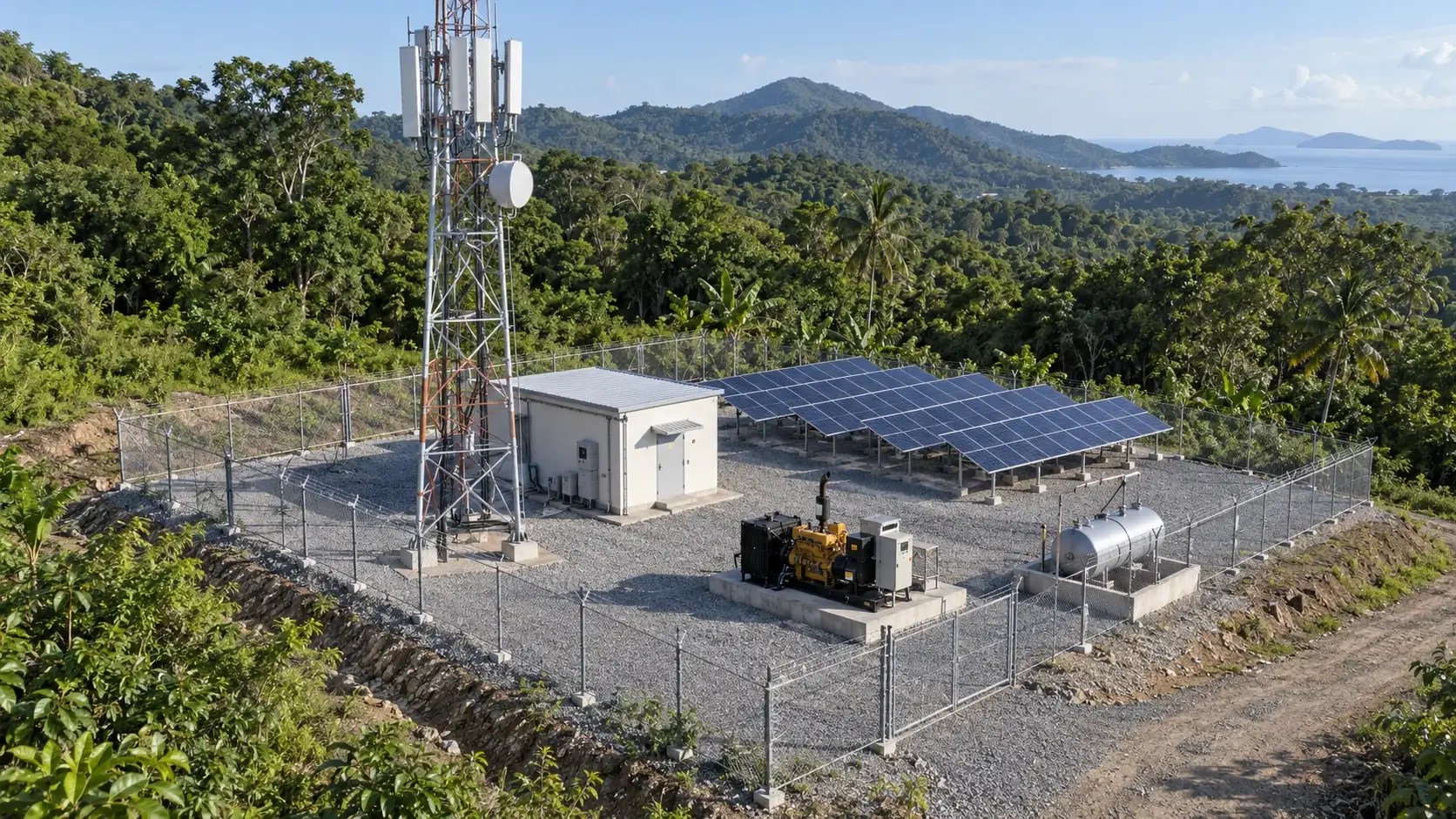
What a Base Station Actually Draws
The load at a base station is driven by the radio configuration first and by cooling second, and both are modest compared with a factory or a resort.
Published site-planning figures put the radio load at roughly 1.3 kW for a 2/2/2 configuration, 2 kW for 4/4/4 and 3 kW for 6/6/6. Add a 1.5-tonne air conditioner and total site demand rises to somewhere between 3 and 4.7 kW. Planning assumptions commonly use 3 kW for a rural site and 5 kW for an urban one; small remote stations and repeaters can sit far lower, in the 150-500 W range, and one measured radio relay station came in at around 4.3 kWh per day.
A measured off-grid case makes the shape of the load clearer than the averages do. During the day the radio and microwave equipment drew about 1,000 W and the air conditioning about 836 W. At night the radio and microwave load fell to around 700 W – a drop of roughly 30%, not the collapse that a commercial or residential load shows after dark.
That flatness is the single most important thing to understand about this application, because it changes what the battery is for.
At a resort or a commercial building, load swings hard between day and night, and a battery earns its keep by carrying a low overnight base that a large generator handles badly. At a base station there is no such collapse. The site needs meaningful power at three in the morning, every night, for as long as the radio is on. A battery at a telecom site is therefore not there to shave a peak. It is there to cover the hours when the sun is not producing, and to hold the site up when everything else has stopped – which is a different sizing problem with a different answer.
This is where the arithmetic from other sectors stops transferring directly. A battery energy storage system sized for a hotel’s overnight base would be badly undersized for a base station that has to survive a cloudy week without starting the generator more than a few times.
Why Diesel Sites Keep the Generator Running
On a diesel-only site the generator is not a backup. It is the power supply, and it runs accordingly.
ITU-APT survey material on mobile tower sites describes diesel-only sites running their generators for 16 to 20 hours a day, with some examples at 24 hours. One documented 20 kVA installation ran 16 hours a day. In a benchmark off-grid case published by Victron, a conventional diesel-only arrangement consumed 22.8 litres a day.
Three things keep those hours high.
The first is that the load never goes away, as the previous section showed, so there is no long low-demand window in which the generator could be shut down.
The second is sizing history. Cummins technical material notes that although the base station load itself is around 2 to 3 kW, generator sets of up to 12 kW have historically been installed because of the starting surge from air conditioning, with the trend since moving down toward roughly 5 kW. An engine sized for a starting surge spends the rest of its life running at a small fraction of its rating, where specific fuel consumption is at its worst and where wet stacking becomes a real maintenance issue over time.
The third is that there is no alternative. Without storage, the generator has to run whenever the site needs power, and the site always needs power.

What Uptime Costs, and What Actually Breaks It
Availability in this industry is measured in the number of nines, and each additional nine is expensive. Telecom Italia’s technical documentation on site availability states plainly that adding a “9” to site availability generally doubles the cost – which is why 99.9% and 99.99% are procurement decisions rather than defaults, and why the design has to be matched to what the site actually needs to deliver.
Published performance shows what the top of that range looks like. Helios Towers reported 99.98% power uptime in 2023, equivalent to about 1 minute 49 seconds of average downtime per tower per week, with a target of 30 seconds per tower per week by 2026; Senegal reached 4 seconds per week and Oman 38 seconds after an 89% reduction. At the other end, the tower company case cited earlier achieved only 83% national availability against a 99.80% target across a network where roughly one site in eight had a fixed generator and about the same share had backup batteries – against a study recommendation that at least 50% should carry backup power.
What separates those outcomes is not the fuel contract. It is what happens when something fails.
Fuel does not always arrive. Diesel has to be transported to the site, and at remote sites that transport is itself a risk – the fuel has to be paid for in advance, moved over roads that may be impassable in the wet season, and delivered to a location with no permanent staff. A site whose generator has run dry is a site that is down, regardless of how good the generator is.
Fuel and equipment get stolen. This is the failure mode that most power-system proposals do not address at all, and it is a large one. Vodacom’s KwaZulu-Natal region reported more than 100 vandalism incidents and 167 battery thefts per month – around 520 batteries, leaving 351 sites without batteries – alongside the loss of over 8,860 litres of generator diesel and cable theft at 212 sites, with restoration costs running around R70,000 per site. A criminal group in Zimbabwe siphoned roughly 9,000 litres of diesel and took four generator batteries from network base stations over a five-month period, in one case threatening guards with a rifle. Nigeria’s regulator recorded 656 critical power assets stolen in 2025 – 152 generators and 504 batteries. A Pakistani Senate sub-committee reviewed over 9,200 theft and vandalism incidents in eleven months, affecting close to 16% of cellular infrastructure.
MITRE’s threat framework for network infrastructure describes battery theft as a potential root cause of cell service outage, precisely because the battery is what carries the site when everything else has failed.
Generators fail when they are needed. A set that has been running 16 hours a day for years is a set approaching overhaul, and the failure it produces is the one that hurts most. Remote sites make this worse: the same distance that makes fuel expensive also makes the technician slow to arrive, and a site that takes four working days to repair is a site carrying four working days of exposure.
Together these three failure modes explain why the availability gap in the case above was so wide. A diesel-only site has a single supply chain, and that chain can be broken by a road, a thief or a bearing.
How Solar, Battery and Diesel Split the Load
A hybrid system does not remove the diesel generator. Every deployment reviewed for this article keeps it. What changes is the job it does, and the hours it does it in.
Solar carries the daytime load. At a site drawing 3 to 4.7 kW in daylight, a PV array of the usual size for this application covers a substantial share of the demand and, where the array is larger than the instantaneous load, puts the surplus into the battery. Typical configurations in this segment run 5 to 15 kWp of PV, with larger sites such as a 134-site tower programme in Southeast Asia deploying around 18.9 kWp per site.
The battery covers the dark hours and the bad weather. Because the base station load barely falls at night, the battery is sized against a real overnight demand rather than against a residual base. Typical banks run 20 to 80 kWh of lithium iron phosphate at 48 VDC, giving 8 to 24 hours of backup depending on configuration. The battery also does the job that no generator can do cheaply: absorbing the short interruptions, the demand swings and the gap between a mains failure and a generator start.
Diesel becomes the resource that runs when it is needed. With solar and storage in front of it, the generator’s role narrows to recharging the battery through extended poor weather and covering periods of unusually high demand. Reported generator run-times in solar-diesel systems drop to 2 to 7 hours a day, and the benchmark case above went from 22.8 litres a day at 16 hours of running to 12.8 litres a day at 8 hours after a 7.5 kVA unit replaced the original set. At the more aggressive end, documented installations have cut a 20 kVA generator from 16 hours a day to 2.5, and another from 10 hours a day to zero.
The operating logic is consistent across deployments: solar powers the site and charges the battery through the day, the battery carries the night, and the generator starts only when the battery needs support. Getting that dispatch right – how much of the load each source takes, and at what state of charge the generator is allowed to start – is what a solar-battery-diesel hybrid microgrid is designed to do, and it is where a system that pays back separates from one that does not. The amount of diesel backup a hybrid microgrid should carry is a related design question, though the answer differs at a base station because the overnight load never falls away.

What Heat Does to the Battery
Most hybrid proposals quote a cycle life from a datasheet. At a base station in a tropical or desert climate, that number rarely survives contact with the site.
Lithium cells are happiest around 20 to 25°C. Above that, capacity de-rates by roughly 1 to 2% per degree, so a cell at 45°C effectively delivers a fifth less than its rating. Sustained operation above 45°C roughly doubles the calendar ageing rate, and every 10°C reduction in average operating temperature can roughly double cycle life. A battery rated for 500 cycles at 25°C in a laboratory may deliver fewer than 300 in a rooftop cabinet sitting at 55°C.
The consequence is direct: a battery that is expected to last the life of the site quietly becomes a replacement item several years early, and the payback calculation that made the project attractive stops holding.
The design response is not simply to add air conditioning. Rectifiers and electronics tolerate 55 to 65°C comfortably, while batteries do not – so cooling the whole cabinet to a battery-safe temperature wastes energy conditioning equipment that does not need it. The standard approach is to separate the battery compartment from the electronics compartment: active cooling for the battery zone, passive heat exchange for the electronics, with a sealed, IP55-rated enclosure and dehumidification in humid climates. A 48 V, 500 Ah lithium bank generates 150 to 300 W of its own heat at peak charge, which has to be removed from a compartment that is otherwise designed to keep the outside out.
Charge and discharge rates matter here too. Keeping the C-rate between 0.25C and 0.5C limits internal heating and holds round-trip efficiency around 90 to 95%, whereas heavy discharge in a 45°C ambient can push cell temperatures past 60°C. Sites that stay above 35°C for long stretches and cannot maintain a reserve state of charge are usually better served by a backup-only duty cycle than by daily cycling.
What the Documented Deployments Show
The figures below are as reported by the researchers, project developers or operators behind them. Configurations differ, so they are a range of outcomes rather than a like-for-like comparison.
| Project | Configuration | Reported outcome |
|---|---|---|
| Multi-site techno-economic study across 2, 12 and 263 base stations (HOMER-optimised) | PV + battery + diesel | LCOE down 29%, generator run-hours down 82%, net present cost down 34% |
| Telecom site, 3.5 kW average load | Hybrid PV + battery + diesel | Diesel consumption down 75%, emergency maintenance visits down 25% |
| 134-site tower programme, Southeast Asia | ~18.9 kWp PV + 38.4 kWh LFP (48 VDC) + diesel genset, 4G monitoring | Automatic generator start/stop under central remote monitoring |
| Off-grid base station, West Africa | Solar PV + lithium-ion storage (up to 6 kW) + diesel genset | Greenhouse gas emissions down up to 80% versus the diesel-only site |
| Conventional off-grid base station, benchmark case | Diesel-only 20 kVA, 16 hrs/day → hybrid with 7.5 kVA unit | 22.8 litres/day → 12.8 litres/day, running hours 16 → 8 |
Read together, three things stand out.
The fuel saving scales with the generation and storage installed, not with the sophistication of the controls. The largest reductions come from the sites with the most solar and the most battery behind them.
The mechanism is always the same. Generator hours fall because the battery lets the site run without the engine – and unlike a resort or a factory, the base station gets that benefit by covering a load that never drops away, not by exploiting a quiet overnight window.
The percentage figures are not transferable. The 75% and 82% reductions above come from well-optimised cases. Savings depend on the ratio of solar and battery to the site’s own load, the solar resource, and how expensive the fuel is to deliver – which is why any figure quoted for a specific site has to be derived from that site’s data.
How telecom operators are approaching this transition more broadly is covered in our earlier analysis of why towers are switching to hybrid solar power.
What Decides the Design at a Given Site
The documented cases give a range, not a promise. Six variables explain most of the difference between a site that performs and one that does not.
The site’s actual load profile, including cooling. Whether the air conditioning runs continuously, on a thermostat, or only above a temperature threshold changes the daily energy requirement more than the radio configuration does. The load has to be measured at the site, not assumed from the antenna count.
The solar resource and its seasonality. Cloud cover in the wet season, not the annual average irradiance, decides how large the array and battery have to be for a site that must stay up through it.
How long it takes to reach the site. A site that can be reached in an hour and a site that needs a flight and a day of driving are different design problems, because accessibility sets how much redundancy the site must carry on board.
Site security. Where battery and diesel theft are active problems, the storage has to be specified with physical protection in mind from the start – hardened cabinets, enclosed compounds, monitored access – rather than treated as an afterthought. The published theft figures suggest this applies across a much wider set of markets than most proposals assume.
Ambient temperature and how it is managed. The thermal design of the battery enclosure has a larger effect on lifetime cost than the choice of cell chemistry at this scale.
The condition of what is already installed. A site with a newer generator approaching its first major service is a different proposition from one running a set that is overdue for overhaul. In the second case, the question is not only how much solar and battery to add, but whether the replacement should be planned differently.
It is worth being clear about what the numbers in this article are not. They are published disclosures from specific programmes, studies and benchmark cases, not a forecast for any particular site. The spread between the 75-82% savings reported at optimised sites and the more modest reductions elsewhere is the honest picture: telecom tower power is a segment where how a solar-battery-diesel system is configured and dispatched decides the outcome, and where the site conditions that drive cost are rarely the ones a standard proposal addresses.
YURI POWER designs and delivers solar-battery-diesel hybrid power systems for telecom sites and other remote and weak-grid applications, working from measured site load, cooling behaviour, access conditions and security exposure rather than from a standard configuration. If you are running a portfolio of base stations on diesel and want to understand what the numbers would look like site by site, our team can work through the load and availability picture with you.
FAQ
Q: Can solar and battery actually keep a base station up through a week of bad weather?
A: Not on their own, and no documented deployment claims they do — the generator stays for exactly this case. What the hybrid design changes is that poor weather increases generator running hours rather than threatening the site. Battery autonomy in the 8-24 hour range covers the overnight period and short cloudy spells; beyond that, the generator recharges the battery and the site stays on air.
Q: How do we stop the batteries being stolen?
A: This has to be designed in, not added later. The measures that operators report using are hardened, steel-clad battery cabinets, alarmed enclosures, CCTV and monitored access, and in some cases community reporting arrangements that have proven effective. The published theft figures — hundreds of batteries a month in some regions — mean that the value of the installed battery is itself a security requirement, and the enclosure specification should follow from that.
Q: Our sites run air conditioning continuously. Does that ruin the economics?
A: It changes them, but it does not remove the case. Cooling is often the largest single load at the site — in a measured off-grid case it was comparable to the radio equipment during the day — and it is what makes the total site demand 3 to 4.7 kW rather than 1.3 to 3 kW. It also means the load never falls away, so the battery has to be sized against a real overnight demand. The right response is to reduce the cooling load where the design allows and size the system against the measured figure, not to assume it away.
Q: How many hours a day will the generator still run?
A: Documented solar-diesel systems report generator run-times in the range of 2 to 7 hours a day, against 16 to 20 hours for diesel-only sites. Where a site lands in that range depends on the solar and battery capacity relative to the load and on the weather during the period measured. The figure for a given site should come from that site’s own load and solar data.
Q: What happens to battery life if the site sits at 45°C?
A: Capacity de-rates by roughly 1 to 2% per degree above 25°C, and sustained operation above 45°C roughly doubles the calendar ageing rate. A battery rated for 500 cycles at 25°C may deliver fewer than 300 in a hot cabinet. This is manageable — separated battery and electronics compartments, active cooling for the battery zone, a sealed IP55 enclosure and moderated charge rates all help — but it has to be part of the design from the start, because a battery that fails early takes the payback calculation with it.
Q: Can we add solar and storage to the generators we already have?
A: In most cases yes, and that is what most of the documented deployments did. The existing generators stay as the firm backup layer while solar and battery are added alongside. Whether it is the better route depends on the age and condition of the installed sets, their suitability for reduced-hours operation, and how their controls integrate with the new system — a generator that has been running 16 hours a day for years is a different starting point from one with low hours.
Q: There is nobody on site. How do we know it is still running?
A: Remote monitoring is standard in this segment. Deployments in the 130-plus-site range operate on 4G-based central management with automatic generator start and stop, which is what makes a hybrid site manageable at portfolio scale — the operator sees state of charge, generator hours and fault conditions without sending anyone to the tower. Monitoring is also what turns a battery from an unmanaged asset into one whose condition can be tracked against its expected life.
YURI POWER Engineering Team · September 20, 2026