
Ask what solar can do for a farm in Africa and the answer usually involves a pump. A solar array drives a borehole or surface pump through the middle of the day, diesel consumption falls, and the numbers work. That answer is correct, and it is also incomplete – because the pump is the easy part.
An irrigation pump is one of the most accommodating loads a farm has. It does not care what time of day it runs, as long as the water arrives inside the crop’s window. It can be scheduled into the hours when the array is producing at full output, throttled back when cloud passes over, and run harder in the afternoon to catch up before the sun drops. A farm that had to power nothing but irrigation could be served by solar and a modest battery, and the design would be close to straightforward.
The loads that make agricultural power systems difficult are the ones that cannot be moved. And on a commercial farming operation, they are usually the loads that matter most to the business.
What the System Actually Is
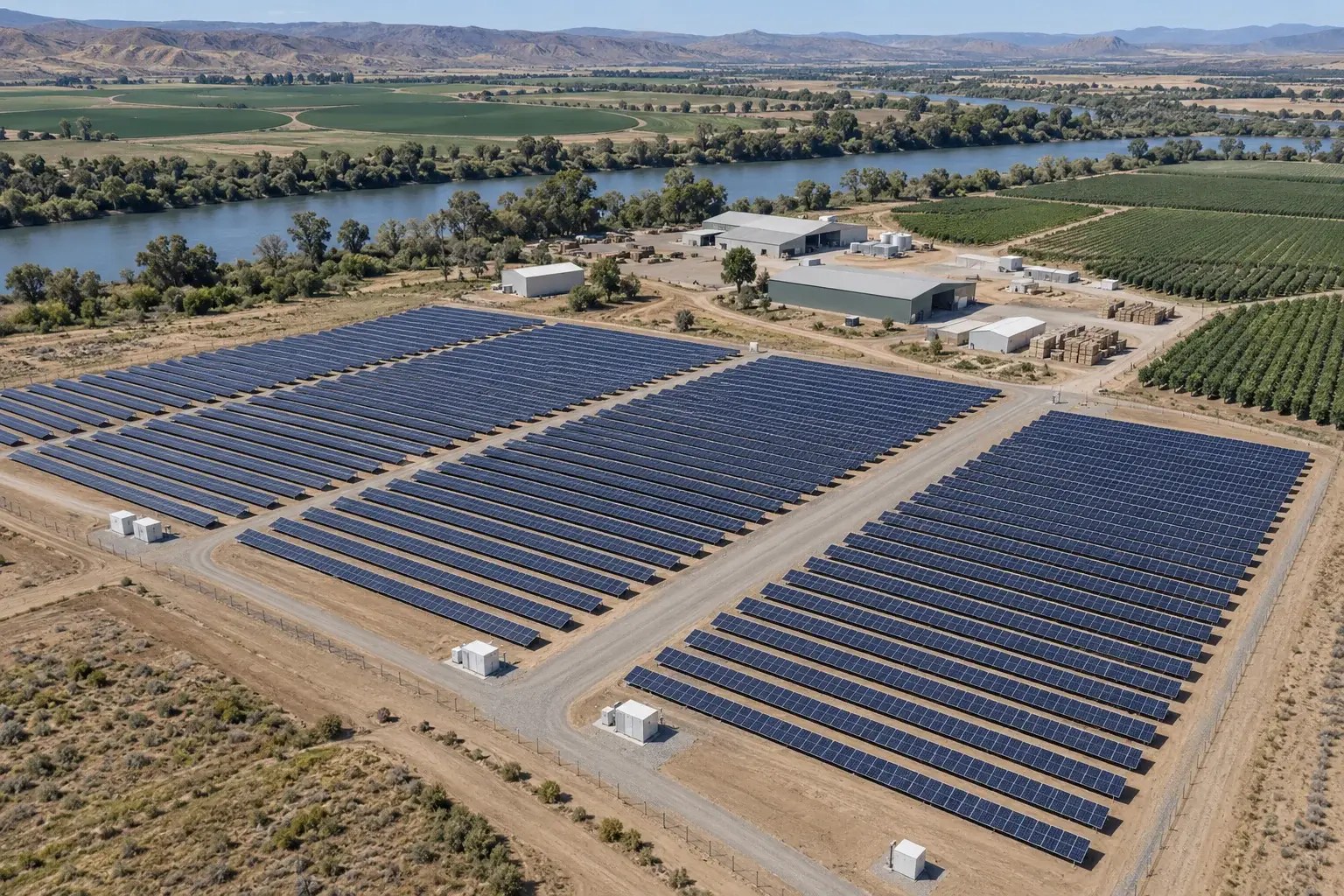
A commercial farming operation in South Africa’s Free State province is currently building what is reported to be the country’s largest off-grid agricultural solar-plus-storage installation, and the shape of it says something about how these systems have to be sized.
| Parameter | Value |
|---|---|
| Solar | 4.89 MWp, ground-mounted |
| Battery | 20 MWh |
| Farm area served | More than 2,000 hectares (~20 km²) |
| Distribution | ~17 km of medium-voltage reticulation |
| Crops | Seed potatoes, ware potatoes, pecan nuts, onions, maize |
| Loads served | Irrigation, cold rooms, packhouses, processing infrastructure |
| Grid connection | None – the system is designed to operate independently of the national grid |
| Status | Under construction, 67% complete, commissioning scheduled for October 2026 |
| Diesel backup | None in the design |
The operation runs a multi-crop production calendar across a footprint large enough that power has to be distributed to pumping stations, cold stores and processing buildings spread over 20 square kilometres. The system is being delivered by an EPC contractor working to a design developed from measured load data rather than a standard commercial template – a distinction that turns out to matter more in agriculture than in almost any other sector.
The decision to go off-grid was driven by cost. Electricity tariffs for the utility’s direct customers rose 18.65% in 2023, 12.72% in 2024, 12.74% in April 2025 and a further 8.76% in April 2026 – a cumulative increase of roughly 45% over three years at this farm. Nationally, electricity accounts for approximately 6% of agricultural production input costs, and materially more for operations with significant cold chain and irrigation demand.
One detail in that table deserves attention before anything else: the battery is rated at 20 MWh of energy with no published power rating. That is worth flagging because it makes one common calculation impossible. You cannot divide 20 MWh by the 4.89 MWp solar figure to get a storage duration – 4.89 MWp is the array’s peak generation capacity, not the inverter’s power rating, and the two are different numbers. What the sizing can be explained by is not arithmetic but the nature of the loads themselves.
Two Kinds of Load on the Same Farm
The single most useful thing to establish about any agricultural power system is which loads can be moved in time and which cannot. Almost every design decision follows from that split.
Deferrable loads can run at any point inside a window. Irrigation is the classic case, and it is deferrable on two separate timescales. Within a day, water can be applied in the morning, at midday or in the late afternoon, provided the soil moisture stays inside the crop’s tolerance band and the irrigation schedule is designed around that flexibility. Across several days, a properly designed system with storage capacity in the soil can absorb a cloudy spell and catch up afterwards. This is what makes irrigation a natural match for solar: the pump’s schedule can follow the array’s output curve rather than the other way round.
Non-deferrable loads have to run when they have to run. Cold rooms are the clearest example on this farm. A cold store holding harvested potatoes, onions or nuts is not a discretionary load with a scheduling window – it is a temperature-controlled asset whose contents begin to degrade the moment cooling stops. The compressor duty cycles continuously, overnight and through cloudy weather, and the consequence of interruption is not a delayed task but spoiled produce.
There is a third category in between, and it is where a lot of agricultural load sits. Packhouses and processing lines can tolerate short interruptions but not long ones, and their operating window is fixed by the harvest calendar rather than by the weather. During harvest, a packhouse may run extended shifts for weeks with no margin for a power interruption; outside harvest, it sits largely idle. This is load that behaves like industrial demand for part of the year and disappears for the rest of it.
| Load | Can it wait for the sun? | What it demands from the battery |
|---|---|---|
| Irrigation pumps | Yes – schedulable into daylight hours within the crop’s water window | Little: the array drives it directly, and storage only covers cloud transients |
| Cold rooms | No – an interruption means spoiled produce | Every hour the array is not producing, plus every hour of an overcast spell |
| Packhouses and processing | Partly – but the window is set by the harvest calendar | Extended shifts through harvest, with almost no margin for interruption |
The reason this classification does the heavy lifting is that these load types have completely different relationships with a battery. A deferrable load barely needs storage at all – the array can drive it directly, and the battery only has to cover the minute-to-minute variation caused by passing cloud. A non-deferrable load has to be carried by the battery through every hour the array is not producing, plus every hour of every overcast day the site has to survive. Those two requirements are not close in size.

Why the Battery Is Sized by the Cold Chain, Not the Irrigation Pump
The project’s own stated rationale for the 20 MWh figure is the clearest evidence for how the sizing actually works. The battery is described as being sized to sustain critical loads through the night and across extended overcast periods, without fallback to diesel or the grid.
Run that requirement against the two load categories from the previous section.
If the system had to serve only deferrable irrigation load, the energy requirement would be measured in minutes to a couple of hours – the battery would be sized to ride through cloud transients and to bridge the short gap between the array dropping off in the evening and the pumps finishing, not to carry a full night of pumping. A small battery paired with a large array would do the job, because the array can meet the energy demand directly for most of the day.
Now add cold rooms, and the requirement changes shape entirely. Overnight in a cold store means ten to fourteen hours of continuous compressor load with zero solar input. Add an extended overcast period – the multi-day weather systems that any site will see in its worst weeks of the year – and the battery is being asked to carry those loads for something closer to two or three days, not one night. The energy requirement scales roughly linearly with the number of hours it has to cover, and the number of hours is set by the weather and the loads’ tolerance for interruption, not by the size of the farm.
That is why “size the system to the farm” is the wrong instruction. Farm area determines how much water the crops need and how much pumping energy that implies – a genuinely important number for sizing the array, since irrigation energy is a large share of total consumption. But it says nothing about the battery. A 500-hectare farm with a large cold store and a packhouse could need more storage than a 2,000-hectare farm that pumps water and ships produce the same day. The variable that governs is the power drawn by loads that cannot be interrupted, multiplied by the number of hours they must be carried – and both terms come from the operating pattern, not the acreage.
This is also the point at which off-grid agricultural design diverges most sharply from the grid-connected version. On a grid-connected site, storage economics are driven by the difference between on-peak and off-peak prices, and the optimal duration is the length of the expensive window. Once the grid is removed, there is no price signal left – the requirement becomes reliability, and the sizing is set by weather sequences and load criticality instead. How long an off-grid battery bank can actually carry a site through consecutive sunless days is a different question from how many hours of peak tariff it can avoid, and it produces a different number.
The Season Problem
Agriculture has a load characteristic that no other sector has to the same degree: consumption does not just vary by time of day, it varies by a factor of several across the year.
On a multi-crop operation, the load curve moves through distinct regimes. During harvest, cold stores run near capacity, packhouses work extended shifts, and processing lines are fully loaded. Between harvests, much of that load disappears – the cold stores may be empty or lightly loaded, the packhouse idle, the processing line stopped. Irrigation follows its own seasonal pattern, driven by crop water requirements and rainfall, and peaks at different times for different crops.
Solar generation varies seasonally as well, but not in step with the load. Depending on latitude and climate, winter output may fall by a significant fraction of summer output, and the cloudy weather that cuts generation is often concentrated in the same season that brings the heaviest load.
The consequence is an asset utilisation problem that anyone financing one of these systems has to confront. The system has to be sized for the worst combination the site will face – peak seasonal load, at night, during an extended overcast spell. For much of the rest of the year, a large part of that capacity sits unused. A battery that cycles hard for three months and gently for the other nine is an expensive way to buy reliability, and there is no way around it if the loads it protects are genuinely non-deferrable.
Two things soften this. The first is crop diversity: a farm running potatoes, onions, maize and nuts does not harvest them all at once, so the peaks are staggered and the annual load curve is flatter than a single-crop operation’s. The second is that irrigation, being deferrable, can be shifted towards the seasons when the array produces most – within the limits of what the crops and the soil can accept.
Neither eliminates the peak. They just change its shape. The sizing still has to answer for the worst week, not the average one.
How Solar, Storage, Inverters and the EMS Divide the Work
Running a farm of this scale without a grid connection means the power system has to do something a grid-connected installation never has to do: create its own reference for voltage and frequency. Everything downstream depends on getting that right.
The array carries the first call on generation. During daylight, solar output goes directly to load – and because irrigation is deferrable, the system can schedule the largest single energy consumer into the hours when the array is producing at its peak. That alignment is the cheapest energy the farm will ever use, because it avoids a round trip through the battery.
The battery covers three distinct jobs. It bridges short transients when cloud cuts array output. It carries the non-deferrable load through the night. And it carries those loads through extended overcast periods, which is the job that sets the total energy capacity required.
The inverters are where the off-grid design gets technically demanding. With no grid to synchronise to, the system needs grid-forming capability – the inverters establish the voltage and frequency reference themselves, and every load on the site follows them rather than the other way round. Hybrid inverters built for grid-forming duty have to hold that reference stable under conditions a grid-tied installation never encounters. The hardest of those conditions on a farm is motor starting: an irrigation pump switched on directly can draw several times its rated current for a fraction of a second, and the inverter has to ride that surge without collapsing the voltage that the cold rooms are running on. Across a site distributing power over 17 km of medium-voltage reticulation, with multiple pumping stations and processing buildings, voltage support at the far end of the network is a design problem in its own right.
The energy management system is what turns this collection of equipment into a system with a policy. On a farm, that policy is load prioritisation. When battery state of charge is falling faster than the weather forecast allows for, the EMS has to decide what gets shed – and the answer is dictated by the deferrable/non-deferrable split. Cold chain comes first, because interruption there destroys product. Processing lines come next, weighted by how close the batch is to completion. Irrigation goes last, because it is the one load that can be moved without loss, up to the limits the crops impose. An energy storage system sized for the worst case still needs a dispatch strategy for the days when the worst case arrives, and on a farm that strategy is written in the language of what can wait.

Whether to Keep a Diesel Generator
This project’s design has no diesel backup at all, and that is a choice worth examining rather than copying.
Removing the generator entirely means the battery has to cover the worst weather the site will realistically see, with no floor underneath it. That pushes up both the energy capacity and the cost. Keeping a generator does the opposite: the battery only has to cover the normal daily cycle and a reasonable margin, because the generator is there for the tail case. A solar-battery-diesel hybrid system trades a smaller battery against fuel consumption, engine maintenance and the logistics of getting diesel to the site on a schedule that survives a bad road.
Which way to go depends on facts that are specific to the site. How long, and how often, does the worst weather actually persist? That is a question for long-term local weather records, not for a rule of thumb – a site whose worst overcast run is two days needs a very different battery from one where it can stretch to five. How much of the load is genuinely non-deferrable, and can any of it be shed for a few hours without loss? And how reliable is fuel delivery – a generator is only backup if the fuel arrives, and on remote sites the delivery chain is often the weakest part of the whole arrangement.
There is also a middle path that is easy to overlook: keep a generator that is small relative to the load, and use it to charge the battery over a few hours during extended bad weather rather than to carry the load directly. The generator runs at its efficient point instead of following a varying load, consumes far less fuel, and the battery still does the work of supplying the site. The generator becomes a charger of last resort rather than a power source, which is a much smaller and cheaper machine.
For a site with a grid connection available at a price the owner can tolerate, none of this applies in the same way – the grid itself is the backup, and the storage sizing question reverts to the price-window arithmetic. It is the absence of that backstop that makes the agricultural off-grid case genuinely harder to size.
What to Measure Before You Size Anything
The engineering team on this project described its method in terms that are worth taking literally: half-hourly consumption analysis across multiple supply points, load behaviour profiled across seasonal agricultural cycles, and assessment of major farm equipment before arriving at a final configuration. That is the right order of operations, and it is the opposite of starting from a catalogue.
Six measurements do most of the work.
Half-hourly load data, per supply point. A farm of this scale is not one load, it is a dozen or more separate ones spread across the property, and their peaks do not necessarily coincide. Interval data at half-hourly resolution, gathered separately at each metering point, shows both the individual load shapes and – critically – how much they overlap. Systems sized on a total annual consumption figure routinely come out wrong because the annual number hides the coincidence.
An explicit list of non-deferrable loads, with power ratings. Not “cold storage” as a category but each compressor, each pump, each line, with its running power and its duty cycle. This list, multiplied by the hours of autonomy required, is the battery sizing calculation. Everything else is an adjustment to it.
The crop water requirement and irrigation schedule. For a multi-crop operation this is several schedules running in parallel, each with its own seasonal peak. This drives array sizing and, because irrigation is the one load large enough to be shifted at will, it also determines how much of the site’s demand can be matched to generation rather than stored.
Long-term weather records, focused on the worst sequences. Not average daily irradiation but the distribution of consecutive overcast days – how long the worst spells run, and how often. This is the input that separates a two-hour battery from a two-day one, and it cannot be estimated from memory or from a typical meteorological year.
Motor starting characteristics. Every large pump and compressor on the site, with its starting method and starting current. This constrains the inverter specification and, at the far end of a long reticulation network, the voltage support design as well.
The failure cost of each load. What actually happens if this load stops for one hour, for four hours, for a day. This is what converts the technical load list into a dispatch priority order, and it is the number that decides where the money goes. Sizing an off-grid microgrid is ultimately an exercise in ranking consequences, not in adding up kilowatt-hours.
YURI POWER designs and delivers solar, battery and diesel hybrid microgrids for agricultural, mining and remote industrial operations – starting from interval load data, non-deferrable load lists and local weather records rather than from a standard configuration. If you are assessing what an off-grid or hybrid system would take at your site, our team can work through the load and cost picture with you.
FAQ
Q: How do we size a battery for a farm with irrigation and cold storage?
A: Separate the loads first. Add up the power drawn by everything that cannot be interrupted – cold rooms, processing lines during harvest, any continuous duty – and multiply by the number of hours it must be carried through the night and through the worst overcast spell your site sees. That gives you the battery’s energy requirement. Irrigation normally does not enter this calculation, because it is deferrable and can be scheduled into daylight hours when the array is producing. Sizing on total farm consumption, or on irrigated area, produces a number that has no clear relationship to what the battery actually has to do.
Q: Can solar and storage replace diesel on a farm completely?
A: It is possible, and this project is designed that way, but the cost of doing it is set by the worst weather the site experiences rather than by the average day. Removing the generator means the battery has to cover the longest overcast run the site realistically faces, with nothing underneath it. Keeping a generator – particularly a small one used to charge the battery during extended bad weather rather than to supply the load directly – can cut the battery size substantially at the cost of fuel, maintenance and a delivery chain. The right answer depends on how long your worst weather lasts and how much of your load can genuinely wait.
Q: What is the biggest mistake in agricultural system design?
A: Sizing from the wrong number. Farm area, annual consumption and peak irrigation demand are all easy to obtain and all commonly used as the basis for a proposal, but none of them determines the battery. What determines it is the power drawn by non-deferrable loads and the number of hours they must be carried. A design built on irrigated hectares will systematically under- or over-size storage depending on how much cold chain and processing the operation happens to have, and the error does not show up until the first extended cloudy spell.
Q: Our farm is on the grid but the tariff keeps rising. Does any of this apply?
A: Some of it. A grid-connected farm keeps the grid as its backup, so the battery does not have to cover the worst weather case – it only has to shift energy out of the expensive tariff periods, and the duration is set by the length of the peak window. But the load classification work is identical and just as valuable: knowing which loads are deferrable tells you how much of your consumption can be moved to cheaper hours, and that is what the storage economics depend on. What changes is the sizing objective, not the analysis.
Q: How much of the load can actually be moved to daytime solar?
A: It depends on the crops and the irrigation system. Where the soil and the irrigation method allow water to be applied in larger, less frequent doses, a substantial share of pumping energy can be scheduled into the middle of the day. Where the crop needs frequent light applications, or where the system is constrained by pump capacity or by water supply, the flexibility is narrower. The way to find out is to work with whoever manages irrigation on the site and establish how much the schedule can actually be moved before any of it is treated as flexible in a design.
Q: What does the inverter have to do that a grid-tied one does not?
A: Create the grid. With no utility connection there is nothing to synchronise to, so the inverters have to establish voltage and frequency themselves and hold them stable while loads switch on and off. The most demanding moment is motor starting – a large irrigation pump switched on directly can draw several times its rated current momentarily, and the inverter has to absorb that without the voltage sagging enough to disturb everything else running at the time. On a site with long distribution runs, holding voltage within limits at the far end of the network is a significant part of the design.
YURI POWER Engineering Team · September 23, 2026