
A mine does not buy electricity. It buys electricity that is available when the mill is running, the crushers are turning and the hoists are moving – which is to say, in every hour of every day. That single requirement has kept diesel generators at the centre of remote mining power for decades, not because diesel is cheap, but because nothing else could promise the same availability.
Solar could not make that promise on its own. A storage-backed solar plant now can, and in August 2026 the first facility of this kind at industrial scale on the continent entered commercial operation at a copper mining complex in the Democratic Republic of the Congo.
The plant delivers 30 MW of firm, round-the-clock power. The more useful question is how it is built – because the sizing behind that number says something about the difference between generating electricity and guaranteeing it.

Generating Power Is Not the Same as Guaranteeing It
A solar array produces energy. It does not, by itself, produce availability.
The distinction is easy to skip past in a market where solar is priced per megawatt-hour, because the price is so attractive. But a megawatt-hour delivered at noon is not interchangeable with one delivered at 8 pm, and at a mine the night shift is not negotiable. Nameplate capacity measures what a plant can produce when conditions allow. It says nothing about what it can deliver when they do not.
That gap is what diesel filled, and filled expensively. A diesel plant is not an efficient machine – it converts fuel to electricity at a fraction of the energy content of that fuel, and the fuel itself has to be trucked to a site that is, by definition, far from anywhere. What it sells is control. It runs when it is told to, at the output it is asked for, for as long as the fuel holds out.
“Renewable baseload” is the claim that solar paired with enough storage can offer that same control. Not the familiar hybrid arrangement, in which solar reduces fuel consumption while a diesel plant continues to set the reliability floor, but solar and storage delivering firm capacity in their own right – the storage carrying the site through the hours the array cannot.
What the Facility Actually Delivers
The plant that reached commercial operation in August 2026 is built around three numbers.
233 MWp of solar PV – more than 357,000 modules across a site described as equivalent in area to 257 football fields.
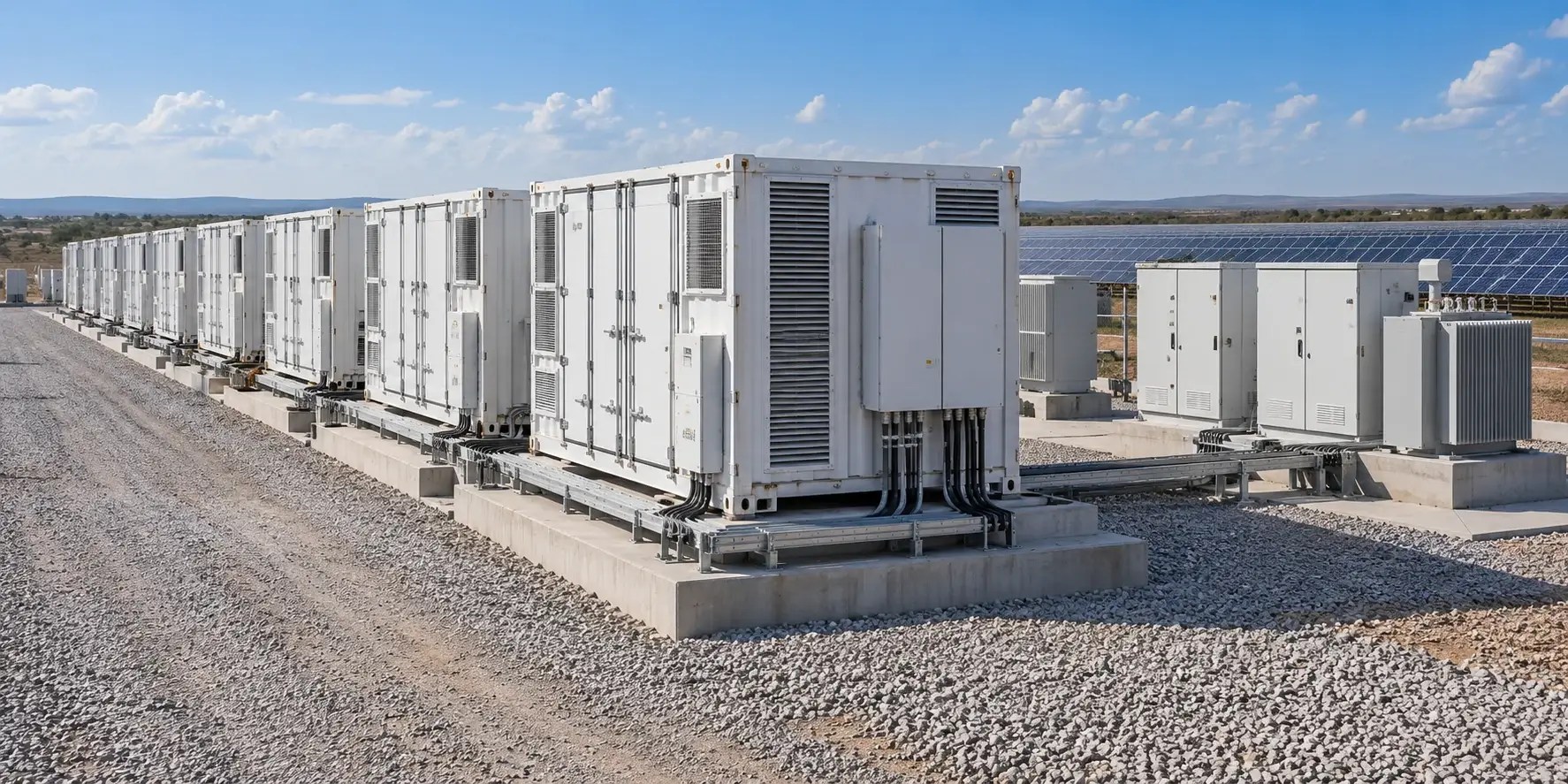
526 MWh of battery storage, rated at 123 MVA and delivered as 180 battery containers.
30 MW of firm capacity, supplied around the clock, with 95% annual availability.
Two details matter as much as the capacities themselves. The first is the word *firm*: the 30 MW is not an average and not a peak, it is a guaranteed continuous output, and an availability figure is what stands behind the guarantee. A plant that promises 95% availability is promising not to be absent more than roughly eighteen days a year, which is a different kind of commitment from a capacity rating.
The second is the timeline. The project went from power purchase agreement to commercial operation in 16 months, against an African average of 29 months for utility-scale solar and battery projects. Construction passed the halfway mark in March 2026 and phased commissioning began in June. Roughly 998 truckloads travelled more than three million kilometres in total, and more than 1,000 local workers were employed on the build. Engineering, procurement, manufacturing and early construction were run in parallel rather than in sequence, which is how the months came out of the schedule.
Why 526 MWh for 30 MW
Divide the energy capacity by the firm output and the arithmetic is striking: 526 MWh against 30 MW works out at more than seventeen hours.
That figure is worth pausing on, because it is a useful correction to the way storage duration tends to be discussed. In commercial and industrial applications, the two-hour configuration dominates – it is what the paired kW and kWh ratings on commercial cabinets are built around, and it exists because peak tariff windows are generally two to four hours long. Nothing about that reasoning applies here.
At a mine with no reliable grid, duration is set by a different question: how many hours a day can the array not carry the load on its own? The array generates for a limited number of hours. Outside them, the battery carries the full 30 MW by itself. A twelve-hour night at 30 MW is 360 MWh before any allowance is made for a bad day – and a plant offering 95% annual availability has to carry an allowance for bad days, which is the same question every off-grid system faces about consecutive days without sun.
Once the requirement is expressed that way, seventeen hours stops looking generous. It is also a floor rather than a target: the battery does not need to be fully drawn down every night, and the array contributes directly for much of the day, so the storage is not cycling its entire capacity daily. What the ratio actually reveals is the shape of the duty – this is a plant sized to cover a night, not to shave a peak.
That sizing logic is not specific to mining. It is the same reasoning that governs any off-grid industrial site, including agricultural operations where the battery is sized by the loads that cannot be moved in time rather than by total consumption. What the mine adds is scale, and a load profile that never drops – a mill does not have an off-season, and the load curve is flat in a way that a farm’s or a resort’s is not.
The arithmetic here is derived from the project’s published capacity figures and firm output. It describes the design logic the numbers imply; it is not a figure published by the developer.
The Cost Gap That Changed the Decision
The technical case for storage-backed baseload has existed for years. What changed is the price.
According to the African Solar Industry Association’s 2026 outlook, published in January, storage now converts daytime solar into fully dispatchable power for around $33 per megawatt-hour. The same report estimates on-site diesel generation at roughly $370 per megawatt-hour, based on a diesel price of $0.85 a litre recorded in Nigeria the previous year.
The comparison is not like for like in every respect – a diesel plant and a solar-plus-storage plant have different capital structures, different maintenance profiles and different fuel exposures – but the order of magnitude is the point. A gap of more than ten to one is not a marginal efficiency difference. It is the difference between a cost line that has to be managed and one that changes what a project can afford to do.
Falling battery cell prices, driven largely by Chinese supply, account for most of the movement. Africa added 2.4 GW of new solar capacity in 2025, and almost every utility-scale project signed in the preceding twelve months paired solar with batteries – where standalone solar had dominated as recently as 2023.
The financing followed. The developer behind this project raised $200 million in senior debt arranged by a South African bank and $40 million in equity from a pan-African climate fund within six months – the largest disclosed capital raise by a commercial and industrial renewable platform on the continent in 2025-26. Mining offtakers sign 15- to 20-year power purchase agreements indexed in dollars and backed by parent-company balance sheets, which turns a solar project into infrastructure-grade credit and lets it attract the kind of senior debt once reserved for utility-scale public procurement.
That structure is the part worth understanding, because it changes who carries what. Under an energy-as-a-service arrangement the mine does not buy a power plant. It buys power, at a contracted price, from a plant it does not own – the capital cost sits with the developer, the fuel-price risk sits with nobody, and the mine’s exposure is limited to the tariff it agreed to.
Why It Took 16 Months Instead of 29
Speed is a financing variable, not just an engineering one. Every month between power purchase agreement and commercial operation is a month of returns deferred, and a project that reaches operation eleven months ahead of the regional norm is a project whose economics improve without anything changing in its design.
The mechanics of that acceleration are unglamorous and mostly logistical. Around 998 truckloads moved more than three million kilometres to reach a site in the Democratic Republic of the Congo’s copperbelt. More than 1,000 local workers were engaged on construction. Engineering, procurement, manufacturing and early construction were advanced simultaneously rather than in sequence, which compresses the schedule but demands that design decisions be finalised earlier and that procurement commitments be made before construction is under way.
None of that is specific to solar. It is the same discipline that separates a well-run infrastructure project from a slow one, and the reason it is worth noting here is that it undercuts a common assumption: that renewable baseload is a technology that works in theory but takes too long to build to be useful. Sixteen months from signature to operation is faster than many diesel plant procurements.
What the Second Phase Says
A second facility at the same complex – 186 MWp of solar with 581 MWh of battery, developed separately with a different technology partner – is scheduled to be commissioned in the third quarter of 2026. Together the two plants will supply 60 MW of continuous baseload power to the mine.
The phase-two numbers are the interesting part. Doubling the firm output from 30 MW to 60 MW required the battery capacity to grow from 526 MWh to a combined 1,107 MWh – roughly proportional, and both phases land on a similar energy-to-power ratio. That consistency is the signature of a design driven by a requirement rather than by what equipment happened to be available: the developer needed to cover the same hours with twice the load, so the storage scaled with the load.
It also signals that the first phase was not a demonstration. Building a second plant on the same site, with the same duty and a second technology partner, is what a company does when the first one works.
What Other Industrial Sites Can Take From This
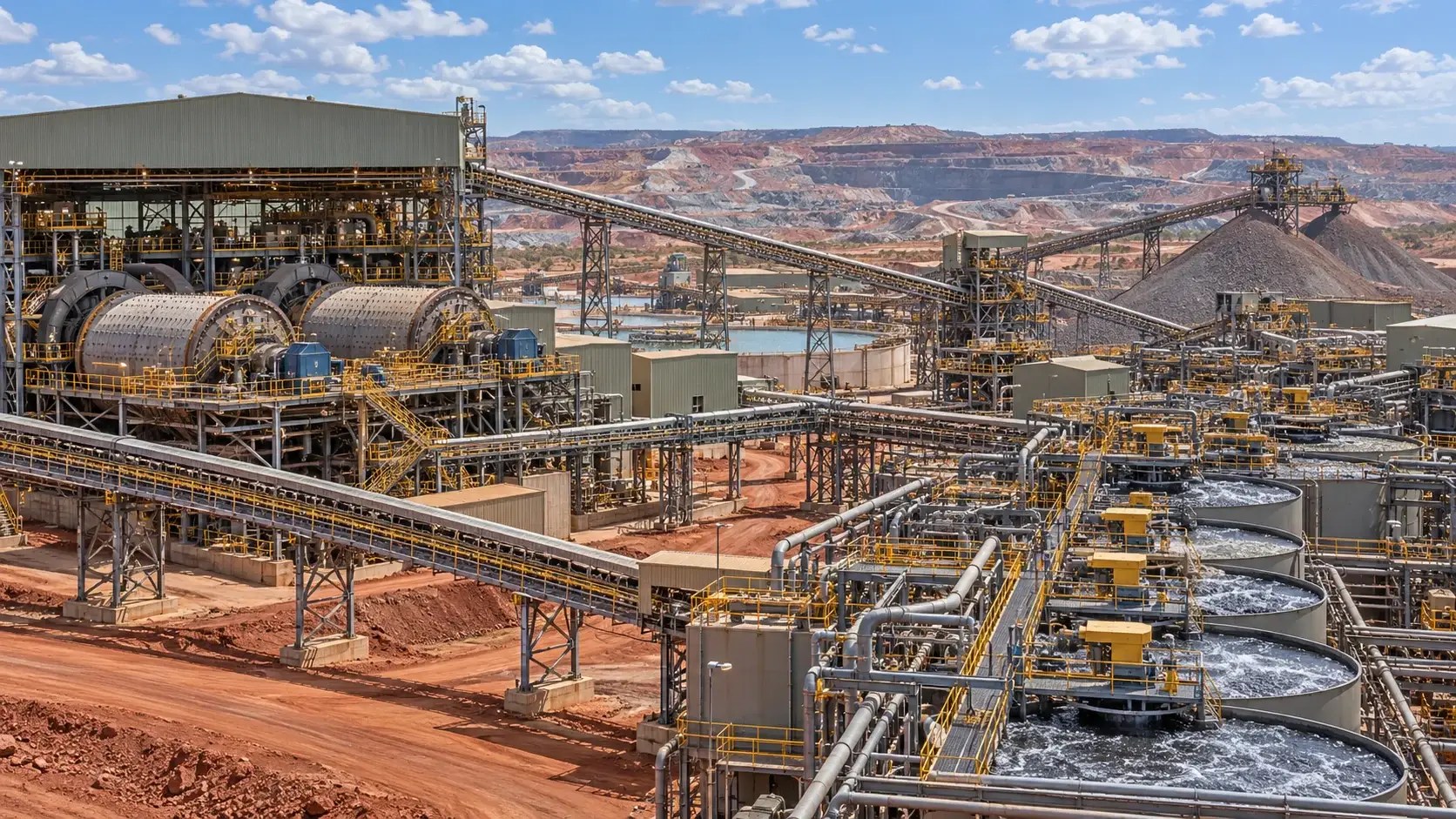
The project is a mining case, but the reasoning transfers to any industrial site where power has to be available continuously and the grid cannot be relied on.
The sizing question is always the same. How many hours a day can generation carry the load without storage, and how many consecutive bad days does the site have to survive? Everything else – array size, battery capacity, the power rating of the inverters – follows from those two numbers.
Availability is the specification, not capacity. Two plants with identical nameplate ratings are not equivalent if one promises 95% availability and the other promises nothing. When power is the input to a production process, an interruption is not an inconvenience, it is a stoppage, and the cost of a stoppage is what the availability figure is protecting against.
The load profile decides the shape. A flat, always-on industrial load is the easiest case for solar-plus-storage, because the battery’s duty is predictable and the array’s output can be sized against a known demand. A load that swings – a crusher starting, a hoist accelerating – puts demands on the inverters rather than the battery, which is why the power rating matters as much as the energy capacity on any mining installation.
Financing structure is a design input. If the capital sits with a developer and the site buys power under a long-term agreement, then the site’s priorities shift from capital cost to contracted tariff and guaranteed availability. That changes which questions are worth asking during specification.
YURI POWER supplies solar-battery-diesel hybrid microgrid solutions and battery energy storage systems for remote industrial and commercial sites, together with the energy management systems that coordinate generation, storage and load. Configuration and technical specifications are confirmed against your site’s load profile, grid conditions and project documentation.
FAQ
Q: Can solar and batteries really replace diesel as a baseload power source?
A: At a site with no reliable grid, they can replace diesel as the source of firm capacity – the plant described here supplies 30 MW continuously with 95% annual availability under a long-term agreement. The qualification is that “baseload” here means firm and dispatchable, not constant generation from a single source: the array generates when it can, the battery carries the load when it cannot, and the combination is what delivers the guarantee. Whether diesel stays on site at all depends on how much margin the design carries for extended bad weather and on whether the local regulations require a backup source.
Q: How much battery storage does an off-grid industrial site need?
A: Work from the hours the array cannot carry the load. Take the site’s continuous load in MW, multiply by the number of hours per day the battery has to cover on its own, then add margin for consecutive overcast days. For a 30 MW continuous load with a twelve-hour night that is already 360 MWh before any weather margin, which is why off-grid storage capacities are measured in hundreds of megawatt-hours rather than tens. The 526 MWh in this project works out at more than seventeen hours against its 30 MW firm output – a ratio that would be absurd for peak shaving and is entirely normal for baseload.
Q: Why is the battery duration so much longer than commercial storage?
A: Because it is sized against a different requirement. Commercial and industrial cabinets cluster around two hours because peak tariff windows are two to four hours long and the economics depend on displacing bought electricity. An off-grid plant is not displacing anything – it is the supply. Its duration is set by how long the sun is down and how many bad days the site must survive, and both of those are measured in hours, not in tariff periods.
Q: What does storage-backed solar cost compared with diesel?
A: The African Solar Industry Association’s 2026 outlook estimates storage-backed dispatchable solar at around $33 per megawatt-hour, against roughly $370 per megawatt-hour for on-site diesel generation at a diesel price of $0.85 a litre. Those are modelled figures rather than contract prices, and the real comparison for any given site depends on its fuel logistics, load profile and financing terms. What the gap indicates is that the decision has moved from “can we afford this” to “why would we not”.
Q: Does a project like this need diesel as backup?
A: That depends on the availability target, the local regulatory position and the consequences of an outage rather than on the technology. A plant designed for 95% annual availability carries margin for bad weather inside its storage capacity; a plant that must not fail under any circumstances – for safety reasons, or because an outage would damage equipment – keeps an additional source. The relevant design question is not “solar or diesel” but how much the last increment of guaranteed availability is worth.
Q: How long does it take to build an off-grid solar-plus-storage plant?
A: The project described here went from power purchase agreement to commercial operation in 16 months, against an African average of 29 months for utility-scale solar and battery projects. The acceleration came from running engineering, procurement, manufacturing and early construction in parallel rather than in sequence, which requires design decisions to be locked in early. For planning purposes, the regional average is the safer assumption unless the project is deliberately structured for parallel delivery.
Q: What kind of industrial sites can use this approach?
A: Any site where power has to be available continuously, the grid cannot be relied on, and the load is substantial enough that diesel is a major cost line. Mining is the clearest case because the loads are large and flat, but the same reasoning applies to mineral processing, cement, large-scale cold storage, water treatment, and any processing operation in a region with weak or unreliable grid supply. The sizing method does not change between sectors – only the load figure does.
YURI POWER Engineering Team · September 28, 2026