
Resorts cannot afford outages — spoiled food, angry guests, and canceled bookings cost real money — yet running diesel around the clock is expensive and noisy. The proven answer is a hybrid microgrid: solar for the day, batteries for the evening and switching, and diesel only as backup. This article explains how to design one that keeps guests comfortable and the business running.
Why Resorts Need Truly Reliable Power
For most businesses, an outage is an inconvenience. For a resort, it is a visible failure in front of paying guests. Real cases show how fast the damage adds up: a Welsh hotel threw out over £10,000 of food after a two-day storm outage, and a Canadian hotel lost more than $30,000 in cancellations over eleven days. In Hawaii, one storm weekend cost the hotel sector an estimated $35-40 million in canceled bookings and closed restaurants.
Restaurants and cold storage are the most exposed. A full walk-in cooler and a busy kitchen become a direct loss the moment the power stops, before a single guest complains. South Africa’s CSIR found that 95% of surveyed accommodation businesses reported moderate to severe harm from electricity cuts. Reliability is not a luxury feature at a resort — it is the product.
A Resort Load Profile Is Not a Factory’s
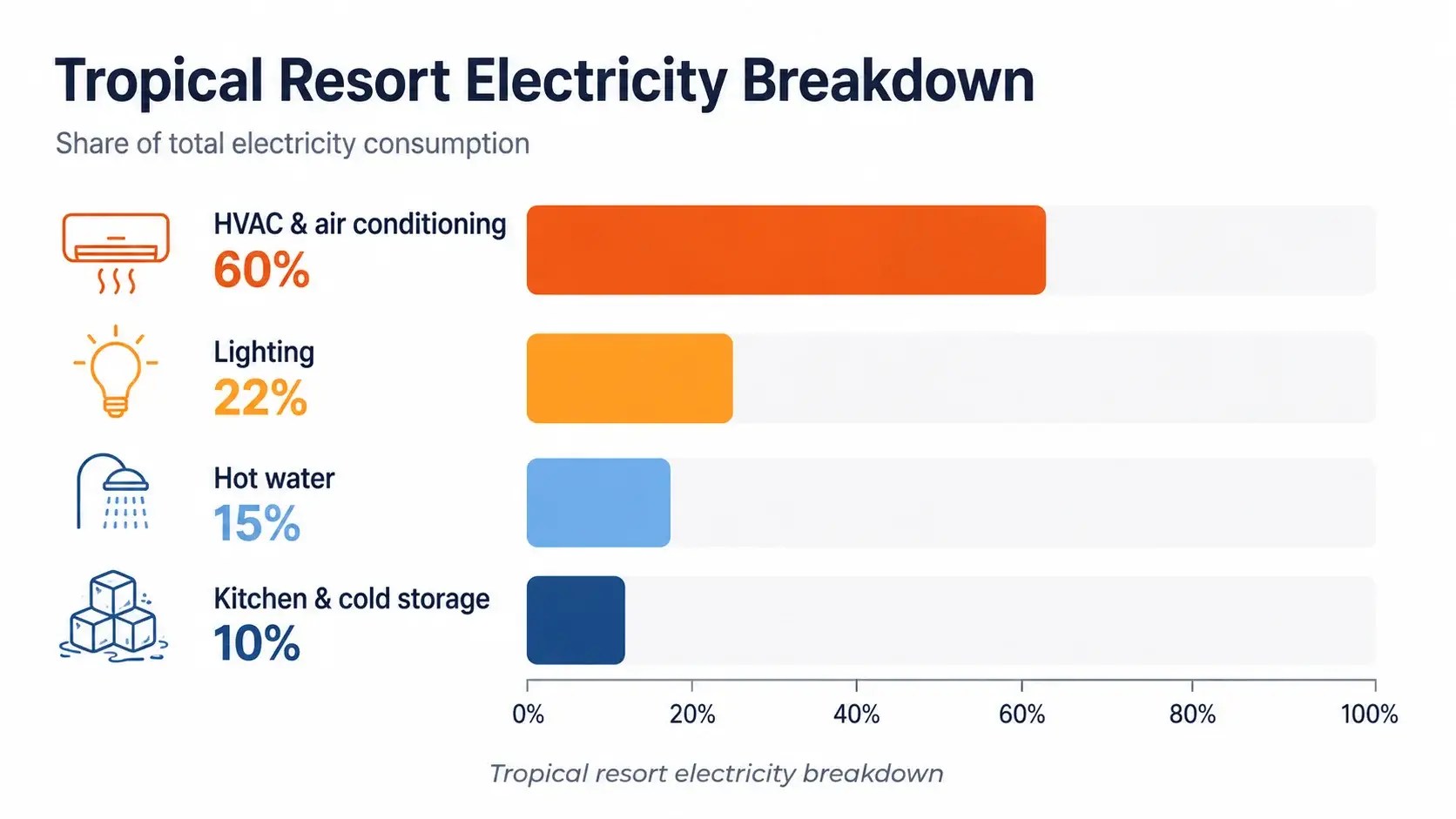
Designing for a resort means designing for a specific, predictable mix of loads. Air conditioning dominates, often 40-50% of electricity in temperate hotels and 60-65% in tropical resorts, where the chiller can be the single largest consumer. Refrigeration and kitchen equipment add another meaningful share — in one Thai beach resort, refrigerators, pumps, and kitchen gear together accounted for roughly 53% of electricity use. Lighting runs about 20-25% and hot water around 15% or more.
The practical point is that loads fall into three groups with very different priorities:
– Critical loads — walk-in cold rooms, kitchen, water supply and treatment, security and communications. These must never drop.
– Deferrable loads — pool pumps, laundry, charging stations. These can shift to off-peak hours.
– Comfort loads — guest-room air conditioning and entertainment. These can be reduced briefly in an emergency without hurting the core business.
A reliable microgrid sizes and schedules around these groups. It keeps the cold rooms and kitchen fed unconditionally, shifts deferrable loads to when solar is plentiful, and treats guest comfort as a controllable reserve rather than a hard commitment.
The Proven Architecture: Solar + Storage + Diesel Backup

Across the remote resorts of the Maldives, Fiji, and the Caribbean, the winning design is the same hybrid: solar PV covers the daytime load, battery storage absorbs the surplus and carries the evening, and diesel generators stay only as backup for extended bad weather and rare shortfalls. Field results speak for themselves:
| Project | Solar + storage | Diesel | Reported result |
|---|---|---|---|
| Kandinma Resort, Maldives | 2 MW PV, 3 MW / 6.8 MWh | 5 MW backup | About 1 million L of diesel saved per year |
| RIU Palace, Maldives | 1,074 kWp PV, 1,064 kWh | Cut from 4 gensets to 1 | About 800,000 L saved per year |
| Gaafu Dhaalu resort, 121 rooms | 410 kWp PV, 264 kW / 327 kWh | 2 × 400 kW backup | About 170,000 L saved per year |
| Yasawa Resorts, Fiji | 1.6 MW modular storage, 3 islands | Backup at minimum load | Remote monitoring across 3 islands |
The diesel generators do not disappear — they get demoted. In the RIU Palace project, the resort went from running four generators to running one, because solar and storage carry the normal load and the single genset only covers the gaps. Most island resorts keep diesel as an insurance policy that runs a few hundred hours a year instead of thousands. Getting fuel to an island is a logistics problem before it is a price problem, as set out in why diesel fuel delivery costs balloon at remote sites.
One engineering caution from the field: a diesel genset must be properly commissioned to run safely in parallel with battery storage. Wiring a battery and a generator together without correct control settings can destabilize the system instead of helping it.
Right-size Each Piece
A reliable resort microgrid is a sizing problem before it is a hardware problem. Three numbers define it:
– Solar size — sized to cover the daytime load and charge the batteries in the good seasons, usually far larger than the average daytime load so it can carry guests, kitchens, and deferrable loads together.
– Storage size — enough to carry the evening and night load and to bridge a generator start, typically several hours of average load, not days. Published island projects range from about 1,064 kWh (RIU Palace) to about 6.8 MWh (Kandinma), sized for the night load and weather windows rather than the whole season. The equipment itself is covered on the battery energy storage page.
– Diesel backup — sized around 20-30% of peak load, or less than the old primary genset, because it only needs to cover critical loads and slowly recharge the battery.
Seasonality is the trap most designs miss. A tropical resort doubles or triples its load in high season. The microgrid must be sized for the peak season day, not the annual average, and the control system should be able to call on the diesel during the short season spike without compromising the rest of the year.
Design for Guests: Noise and Sight Lines
A microgrid that keeps the lights on but ruins the beach view has failed. Two constraints make resort power plants different from industrial ones.
Noise. A bare diesel generator outdoors can exceed 100 dB at close range. Containerized or soundproofed units bring that down to about 68 dB at one meter — roughly the level of normal conversation — using sound absorption, insulation, and vibration isolation. Place gensets away from guest blocks and orient exhausts away from pools and beach loungers.
Sight lines. Containerized solar storage and gensets arrive as neat, painted modules that read as part of the resort rather than as industrial clutter. On remote islands they are typically delivered by container anyway, so modular, marine-rated equipment is both practical and unobtrusive.
Guest comfort also means the transition is invisible. The switch between solar, battery, and diesel must be seamless enough that a guest in a hot shower never notices the grid change. Grid-forming battery inverters that emulate a generator’s behavior keep frequency and voltage stable through the handover.
Build in Redundancy and Remote Control
Reliability at a resort comes from design redundancy, not from hoping one machine never fails. Run multiple smaller gensets in parallel rather than one giant unit: if one is down for maintenance, the others automatically carry the load, so a spare part or service visit never becomes a site-wide outage. This N+1 arrangement is the same standard used for data-center critical loads.
Remote monitoring matters more at a resort than almost anywhere else. Islands have no local electricians to spare, and a service call may take days. A cloud dashboard showing solar output, battery state, generator status, and live load — with remote start and fault alerts — lets one operator manage an entire island chain from a laptop. In the Yasawa project, the owner watches all three islands from one app and uses the data to plan new rooms and restaurants against available power. The cost of the diesel that this design displaces is set out in what running a remote resort on diesel costs.
FAQ
Q: Do resorts still need diesel generators if they have solar and batteries?
A: Most keep a small diesel backup, and for good reason — extended cloudy weather and peak-season surges still need a source that is not weather dependent. The genset’s job changes from running the resort to covering the rare gap, so it runs a few hundred hours a year instead of thousands.
Q: How much battery storage does an island resort need?
A: Enough to carry the night load and bridge a generator start — typically several hours of average load. Published resort projects range from about 327 kWh for a 121-room property to 6.8-40 MWh for larger resorts. Sizing is driven by the high-season evening load, not the annual average.
Q: How noisy is a backup generator at a resort?
A: A bare generator can exceed 100 dB nearby. A containerized or soundproofed unit is typically around 68 dB at one meter — close to normal conversation — which is why island resorts house gensets in acoustic enclosures away from guest areas.
Q: What happens if one generator breaks down?
A: Run several smaller gensets in parallel instead of one large one. With N+1 redundancy, the remaining units automatically take the load, so maintenance or a fault on one unit never interrupts the resort.
Q: How much diesel can a resort save with a hybrid microgrid?
A: Reported island projects save roughly 170,000 to 1,000,000 litres of diesel per year, with several resorts cutting their generator fleet from four units to one. Exact savings depend on solar resource, load profile, and how aggressively the control system prefers renewable energy.
YURI POWER Engineering Team · August 25, 2026