
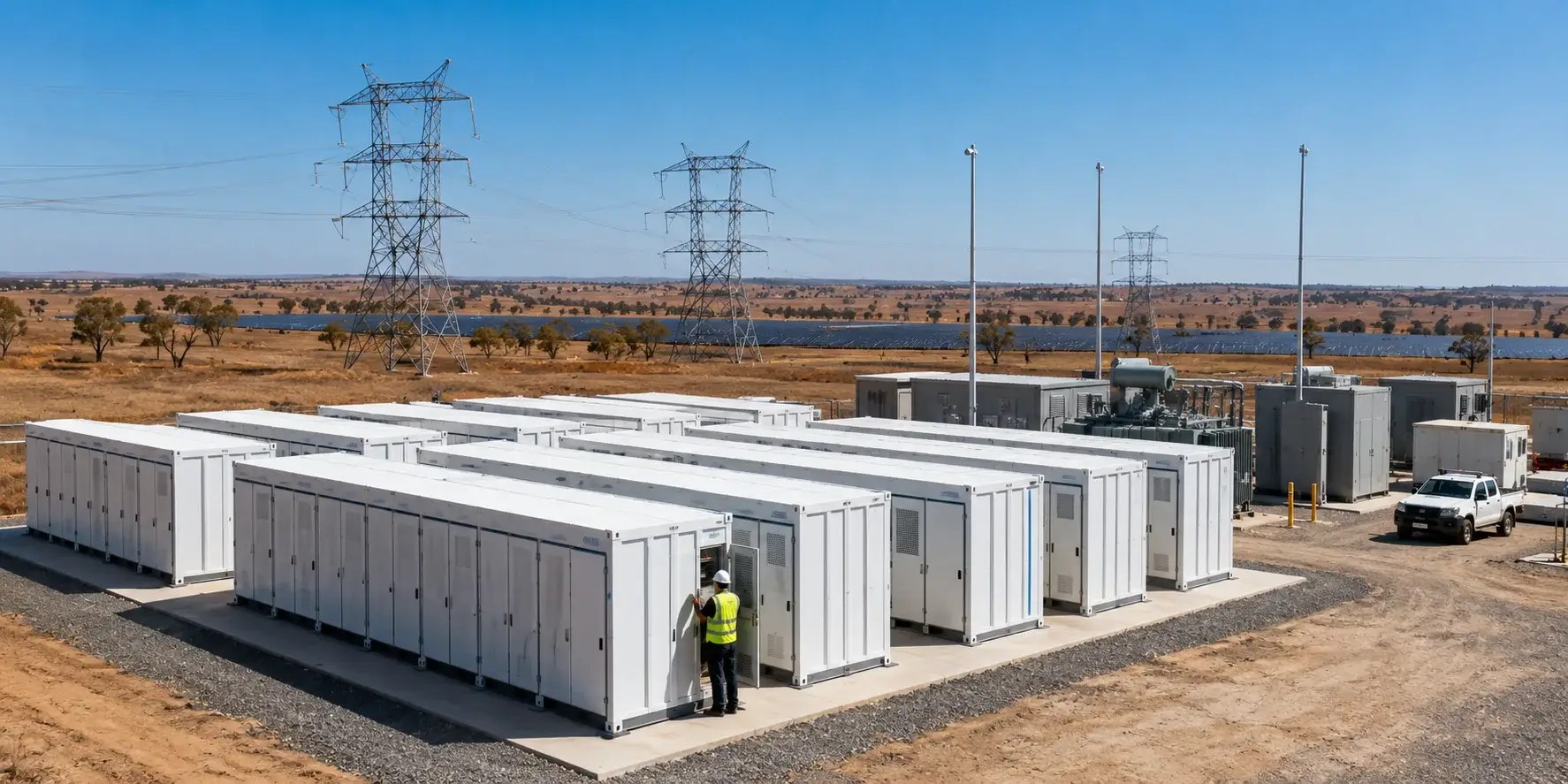
Australia’s market operator AEMO has made its answer explicit: renewable energy firmed by storage and connected by upgraded networks is the cheapest way to power the National Electricity Market to 2050. Battery projects already make up about half of the grid connection queue, and AEMO plans grid-scale storage to grow from about 7.7 GW today to 33 GW by 2030. This article explains why BESS has moved from storing power to holding the system together.
The ISP’s Answer: Renewables + Storage Is the Cheapest Path
AEMO publishes a biennial Integrated System Plan (ISP) that models the lowest-cost way to keep the NEM secure as coal retires and demand nearly doubles. The final 2026 ISP, published in June, tested about a thousand combinations of generation, storage, network, and consumer investments and reached the same conclusion it has been converging on for years: the cheapest path to 2050 is large-scale renewables firmed with storage, connected by upgraded transmission, and backed up by a smaller layer of flexible gas.
The headline targets show how central storage has become:
– 33 GW of grid-scale storage by 2030 — double the 2024 outlook.
– About 40 GW of utility storage by 2050, split into 35 GW of short- and medium-duration batteries for daily firming and 5 GW of long-duration storage, mostly pumped hydro, for seasonal reliability.
– 17 GW of flexible gas — down from the roughly 8 GW of peaking plant operating today.
– About 6,000 km of new transmission — sharply lower than the 10,000 km in the 2022 plan, in part because storage does part of the network’s job.
– 82% renewables by 2030 and 98% by 2050, with most coal exiting by 2038.
The plan’s capital bill fell from about $122 billion a year in the 2024 ISP to roughly $106 billion, driven by cheaper solar and batteries — the first sign that storage is not just the technically favoured option but the cost-favoured one too.
Batteries Now Dominate the Connection Queue
The queue tells the same story as the plan. In the first quarter of 2026, 67.3 GW of projects were progressing through the NEM connection process — up 33% year on year — and battery storage made up 49% of that capacity, about half of everything in the pipeline. Standalone battery capacity alone grew from 20.5 GW to 33.2 GW in twelve months.
Two details in the queue matter for how the system runs. About 74% of the battery projects are grid-forming, meaning they can create the stable voltage and frequency that the system used to get from spinning generators. And batteries now lead every stage of the connection process — application, registration, and commissioning — while gas in the pipeline fell 74%.
The context is a pair of converging trends. AEMO expects electricity demand to rise about 28% by 2035, at the same time as roughly 11 GW of coal-fired capacity retires over the next decade — Eraring, Bayswater, Vales Point, Yallourn, and Callide B among them. Something must hold the evening peak while that gap opens, and batteries are the technology filling it.
Four Roles That Make BESS Central
Calling batteries “storage” undersells what they now do in the NEM. In practice, a grid-scale battery earns its place through four roles:
1. Peak support. The traditional job of a gas peaker — supplying the evening demand peak — is moving to batteries, which can be online in milliseconds and discharge for the two to four hours the peak lasts. As the 11 GW of coal retires, batteries are the immediate replacement in the evening window.
2. Energy shifting. Australia’s solar is already overshooting demand in the middle of the day. Batteries capture that surplus and release it at night — moving energy across the day instead of letting it spill. This is the mechanism that lets the system absorb high renewable penetrations without wasting generation.
3. System stability. Historically, the rotating mass of generators kept frequency and voltage stable. As those generators leave, grid-forming batteries provide the same system strength — which is why three quarters of new battery projects in the queue are grid-forming. Batteries also dominate frequency control services, responding in milliseconds where gas units take minutes to ramp.
4. Renewable integration. By absorbing excess solar and wind, batteries reduce curtailment and defer network upgrades. This is partly why AEMO’s transmission build fell from 10,000 km in the 2022 plan to about 6,000 km — storage does some of the work that new lines used to do.
The Numbers Behind the Shift

The scale of the transition is easier to read as a sequence: the NEM’s operating battery fleet reached about 7.7 GW and 17.7 GWh across 52 assets in mid-2026, including recent additions such as the Swanbank BESS (250 MW/500 MWh) and Limondale BESS (50 MW/400 MWh). AEMO’s plan then carries the system from that 7.7 GW to 33 GW by 2030 and about 40 GW by 2050 — roughly a fivefold increase from where the market is today.
– 2026 (now): about 7.7 GW / 17.7 GWh operating
– 2030 (ISP target): 33 GW grid-scale storage
– 2050 (ISP path): about 40 GW utility storage (35 GW short/medium + 5 GW long-duration)
Behind the scenes, consumer batteries add another layer: about 600,000 homes now have batteries, and AEMO estimates that coordinating roughly half of consumer energy resources could avoid up to $5 billion in grid-scale storage investment.
What It Means for Developers and EPCs
For companies designing, building, or operating energy systems, the Australian shift is a demand signal, not just a policy statement:
– The market for BESS design and integration is scaling. A pipeline of 33 GW of standalone battery capacity means years of siting, grid-connection studies, protection design, and commissioning work — the exact engineering services that define a well-run project.
– Grid-forming is becoming the default requirement. Connection studies now routinely ask whether a battery can provide system strength, not just whether it can charge and discharge. Design teams need the controls and inverter specifications to prove it.
– Hybridisation is next. As solar overbuilds and the evening peak tightens, solar-plus-storage hybrids and batteries paired with existing thermal assets are the natural progression — the same engineering pattern applied at utility scale.
FAQ
Q: How much grid-scale battery storage does Australia have?
A: The NEM’s operating battery fleet reached about 7.7 GW / 17.7 GWh across 52 assets in mid-2026, with roughly 1,975 MW added in the second quarter alone.
Q: What is the AEMO 2026 ISP target for storage?
A: AEMO’s 2026 Integrated System Plan targets 33 GW of grid-scale storage by 2030 and about 40 GW of utility storage by 2050 (35 GW short/medium-duration plus 5 GW long-duration).
Q: Why are batteries about half of Australia’s connection queue?
A: In Q1 2026 batteries made up 49% of the 67.3 GW of projects in the NEM connection pipeline, driven by coal retirements, rising demand, and batteries’ fast response and system-strength services.
Q: What does grid-forming mean for battery projects?
A: Grid-forming batteries create the stable voltage and frequency the grid needs, replacing services once provided by spinning generators. About 74% of new battery projects in the NEM queue are grid-forming.
Q: Are batteries replacing gas peakers in Australia?
A: In large part, yes. Batteries respond in milliseconds and can discharge through the evening peak, moving the peak-supply role from gas units to storage, with flexible gas retained as a thinner backup layer.
YURI POWER Engineering Team · August 28, 2026