
In late August 2026, Saudi Arabia’s Power Procurement Company signed agreements for four battery energy storage projects totalling 2 GW / 8 GWh — a single procurement round roughly one-sixth of the country’s 2030 storage target of 48 GWh. For designers, the interesting part is not the headline number but what it reveals about how the Middle East is building power systems. The region’s projects increasingly share the same architecture: solar as the main source, battery storage as the regulating layer, and — for off-grid, remote, and critical loads — backup generation that runs only when it must. Here is how those systems are actually designed.
The News Anchor: Saudi Arabia’s 2 GW / 8 GWh Storage Procurement
On 23 August 2026, Saudi Power Procurement Company (SPPC) signed four 15-year Storage Services Agreements totalling 2,000 MW of power and 8,000 MWh of energy — an investment of about SAR 4.35 billion (roughly USD 1.16 billion). Each project is sized at 500 MW / 2,000 MWh, four hours of duration, under a build-own-operate model that keeps the winners responsible for performance across the asset’s life.

A group led by Saudi Electricity Company, ACWA Power, and Al Sharif won Al Muwyah and Haden in the Makkah region and Al-Kahafa in Hail; a second group led by ENGIE and Haji Abdullah Ali Reza won Al Khushaybi in Qassim. The same month, SPPC advanced a second round into procurement — 3 GW / 12 GWh across six projects.
This scale is not a pilot. Four-hour systems, fifteen-year commitments, and long-term performance responsibility push hybrid design toward the mainstream — what was once a niche engineering question is now the default answer for much of the region’s new capacity.
Why Energy Storage Is Growing So Fast in the Middle East
Three forces are pulling storage into the centre of Middle East power design.
Economics. Solar generation is cheap and sunshine abundant, so daytime energy prices in many markets are extremely low. But the evening peak — driven by air conditioning — still has to be met. Four-hour storage exists precisely to bridge that window.
Reliability. Grids are expanding quickly, and extreme heat already tests generation and transmission in summer. Batteries provide fast frequency response and short-duration capacity without the ramp constraints of conventional plants, close to where the load is.
Policy. Saudi Arabia’s 2030 target of 48 GWh of storage is one of several national plans across the region that put storage in the capacity plan rather than leaving it to pilots.
Solar + Storage as the Backbone
The dominant operating philosophy in Middle East hybrid projects is “PV priority, storage regulation, diesel backup”: solar generates whenever the sun is available, the battery absorbs the surplus and discharges when needed, and the generator runs only when neither can cover the load.
This hierarchy is visible in the four-hour sizing of the Saudi projects. Four hours tracks the evening peak: a hot-country load curve rises sharply in the late afternoon and stays high into the evening, so a battery sized for four hours at the system’s discharge rate covers exactly that stretch, turning daytime solar surplus into evening supply without running thermal generation.

On-grid, the storage layer performs several roles at once: price arbitrage, peak capacity, frequency regulation, and firming of variable solar. In microgrids the same hardware does the same jobs, but it also becomes the islanding backbone — the unit that holds the system together when the grid is unavailable.
When Backup Generation Is Still Needed: Off-Grid and Critical Loads
Not every Middle East project sits on a strong grid. Mines, camps, remote facilities, and islands build microgrids that must stand alone, and many still include backup generation — not a failure of solar or storage, but honest design for the conditions the site faces.
A backup generator earns its place in three situations:
– Weak or absent grids. Remote sites cannot rely on a utility connection, so the system must run with no grid at all.
– Critical and continuous loads. Hospitals, data centres, and process plants need a last line of defence that does not depend on weather.
– Multi-day weather events. A dust storm can cut solar output hard for days; when the battery cannot cover that stretch on its own, a generator is the cheapest insurance.
The operating model is typically “diesel as insurance, not as the main engine”. In one Riyadh-area workers’ camp, a 2.3 MW PV array with 2.5 MWh of storage and a diesel generator cut the electricity bill to roughly 30% of what the camp paid running diesel alone. On an isolated island microgrid in Dubai, a 3.5 MW / 14 MWh BESS carries the load day to day and the diesels sit as standby. In both cases the diesel hours per year are low — but the diesel is there, sized and fuelled, for the days when solar and storage alone will not close the gap.
Designing backup generation in a hybrid system differs from designing a diesel plant. The generator is not sized to peak load; it is sized to cover what solar and battery cannot, at an efficient operating point. Fuel logistics, storage, and delivery — often the most expensive line item on a remote site — are part of the design from day one.
The EMS: Coordinating Solar, Battery, and Backup Generation
A microgrid with solar, storage, and a generator is only as good as the system that decides each second which source carries the load — the energy management system, or EMS.
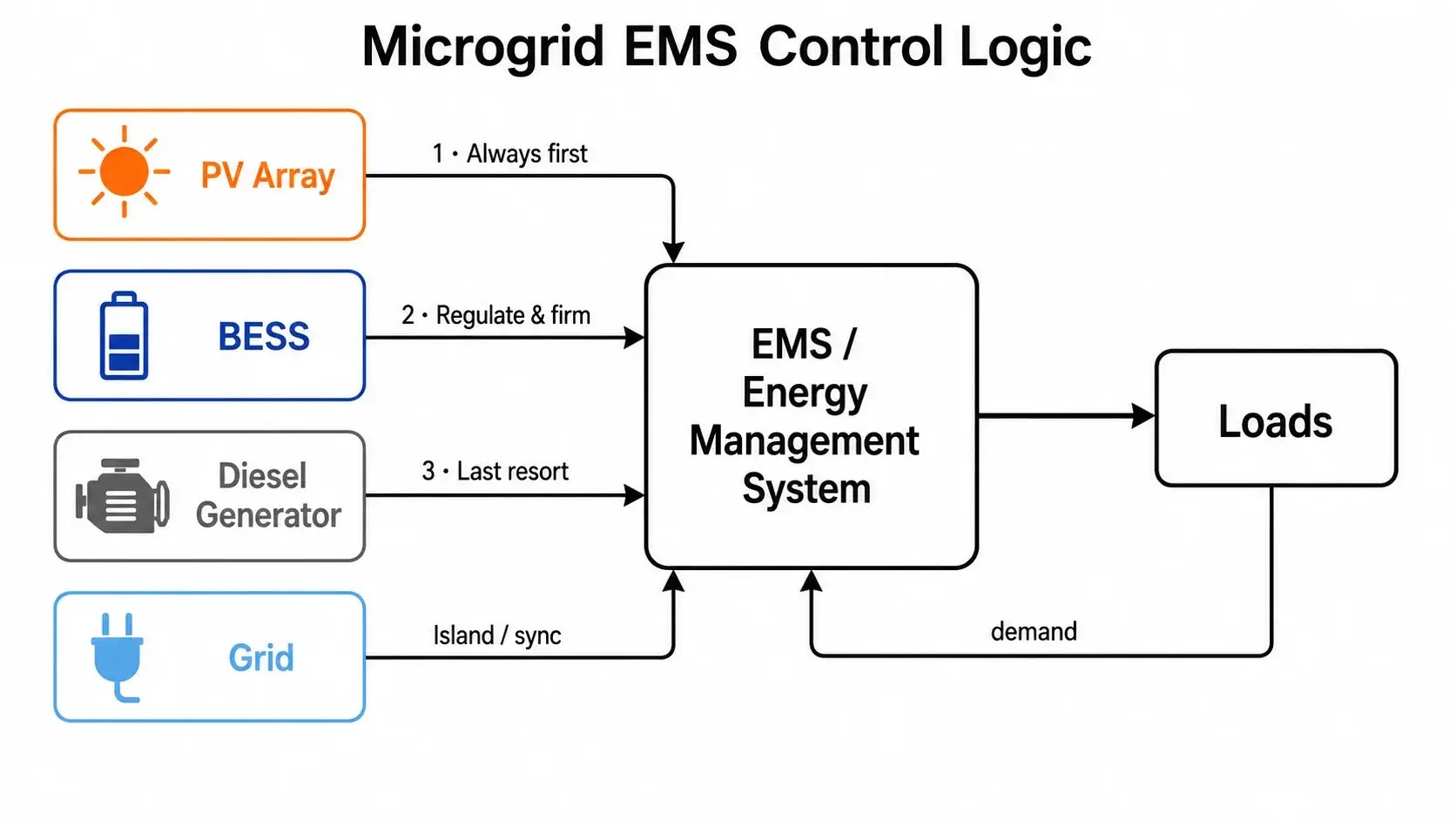
The EMS turns the “PV priority, storage regulation, diesel backup” philosophy into a concrete, minute-by-minute control sequence:
– PV first. Solar inverters track maximum power whenever the sun is available; the EMS never curtails solar while battery headroom or load exists.
– Battery as the regulating layer. The EMS decides when the battery charges from surplus solar, discharges into the load, holds reserve, and provides frequency support.
– Generator as the last resort. The EMS starts the generator only when battery state of charge and PV output together cannot cover the load — and does so in a controlled way, loading it to an efficient point rather than letting it hunt.
– Load management. Where rules allow, the EMS sheds non-critical loads first, keeping essential circuits running.
– Grid interface. The same controller handles the transition between grid-connected and islanded operation without a trip.
The hard part of EMS design is not the hardware — it is the decision logic under uncertainty. When does a falling state of charge trigger the generator, given that a dust storm may be coming tomorrow? How much reserve must stay in the battery when the grid is absent? Good EMS design answers these questions in advance with setpoints, forecast logic, and failure paths.
Design Considerations Specific to the Middle East
Beyond the architecture, Middle East projects carry a few design considerations that shape every decision:
– High ambient temperature. Battery and inverter ratings are de-rated for hot climates, and thermal management is part of the design.
– Dust and sand. PV output degrades quickly under dust, so tilt angles, self-cleaning options, and washing schedules are designed in from the start.
– The four-hour window. Matching storage duration to the evening peak is the most important sizing decision for on-grid projects in the region.
– Backup fuel security. For off-grid sites, fuel storage and delivery reliability can matter more than the generator’s price; running out of fuel is the same as having no generator.
– Operations over decades. Fifteen-year agreements mean the design must favour components that can be maintained, not just purchased.
FAQ
Q: What role does battery storage play in a Middle East microgrid?
A: It is the regulating layer — absorbing surplus solar, smoothing output, discharging across the evening peak, providing frequency support, and acting as the backbone off-grid.
Q: Why is four hours such a common storage duration in the region?
A: Four hours at the system’s rated discharge rate matches the air-conditioning-driven evening peak, letting daytime solar surplus carry the load without running thermal generation.
Q: When is backup generation still needed in a solar-plus-storage system?
A: At weak or absent grids, for critical continuous loads, and through multi-day weather events such as dust storms that cut solar output when the battery alone cannot cover the gap.
Q: How does the EMS decide when to run the generator?
A: It runs the generator only when PV output and battery state of charge together cannot cover the load, starting it in a controlled way at an efficient operating point instead of letting it cycle unnecessarily.
Q: How large is Saudi Arabia’s 2 GW / 8 GWh storage procurement relative to national targets?
A: They total 2 GW / 8 GWh — roughly one-sixth of Saudi Arabia’s 2030 target of 48 GWh.
YURI POWER Engineering Team · September 2, 2026