
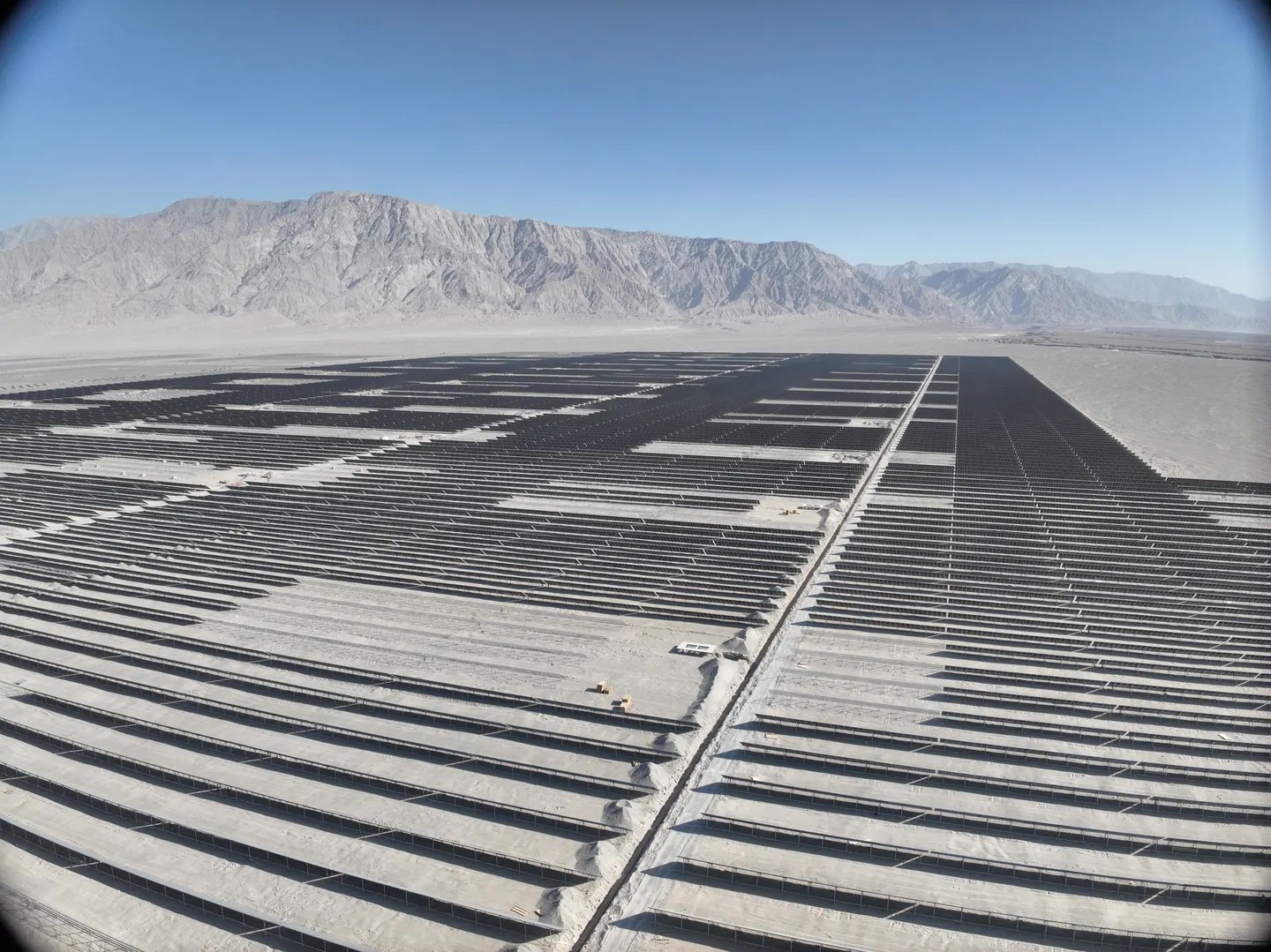
A desert site looks like the easiest place in the world to build a solar project. Irradiation is high, cloud cover is low, land is cheap and nothing casts a shadow. On paper the resource is better than almost anywhere else.
In practice, arid sites are among the most demanding places to get a power system right, because three conditions arrive together and each one changes a different decision. Heat reduces what equipment can deliver. Dust reduces what the array can produce and how long the equipment lasts. Water — or the absence of it — decides how the site is maintained for the next twenty years.
This article sets out how those conditions shape the design of a solar, storage and backup system on desert and arid sites, and which decisions they change compared with a temperate project.

Why a Desert Site Is Not Just a Sunny Site
The first mistake on an arid project is treating high irradiation as the headline number and everything else as detail. Irradiation determines how much energy arrives. It does not determine how much the system delivers, because three losses sit between the two.
The first is thermal. A module rated at a standard test condition produces less at the temperature a desert array actually reaches in the afternoon, and the gap widens on a roof or a ground mount with restricted airflow behind it.
The second is soiling. Dust accumulates on the glass faster than in almost any other environment, and the loss is not linear — a thin uniform film costs a few percent, while a dust event that leaves streaks and drifts can cost far more until it is cleaned.
The third is availability. Equipment that trips on over-temperature, or that has to be shut down for cleaning, produces nothing during the hours it is offline, and those hours are usually the ones with the highest irradiance.
A desert design therefore starts from the environment rather than from the array. The useful questions are the ones that describe the site: how hot the air gets in the shade and in the sun, how often dust events occur, what water is available and how far the site is from the people who will maintain it. Those answers decide the equipment long before the capacity does.
Dust: The Load Nobody Specifies
Dust is the condition most often underestimated in a specification and the one that shapes the most hardware.
On the array, soiling reduces transmittance and can become uneven across a large site, because wind deposits differently depending on row orientation, terrain and the shelter of the ground. Uneven soiling matters more than average soiling on a site with string-level electronics, because a heavily soiled string can drag down its neighbours in ways that a simple average loss figure hides.
On the equipment, dust enters wherever air enters. Inverters, transformers, generator enclosures and battery rooms all depend on airflow for cooling, and every airflow path is also a dust path. The specification response is not simply a higher IP rating. A sealed enclosure solves ingress but can make thermal management harder, and a filtered enclosure needs a filter maintenance routine that the site can actually keep up with. What the enclosure has to protect against, and what it cannot protect against, is set out in IP ratings, corrosion classes and what they protect on desert and coastal sites.
The practical consequence is that the enclosure strategy has to be designed with the maintenance routine rather than before it. An enclosure rated for the environment but impossible to service on site becomes an enclosure that is left open.
Heat, Temperature Swing and What They Do to Equipment
Heat is the second condition, and it affects every component differently.
Modules lose output as cell temperature rises. Inverters derate once their internal temperature crosses a threshold, which usually happens in the early afternoon — exactly when generation peaks. Transformers run hotter and age faster. Diesel generators lose usable capacity at high ambient temperature and altitude, and a set selected on its nameplate rating can be undersized for the site it is installed on.
Storage is the component where heat matters most, because battery life is a function of temperature history rather than of a single design point. A battery room that reaches high temperatures in summer will age faster than its cycle count suggests, and the derating is not uniform across the year. How much capacity is actually available at high ambient temperature, and what that means for sizing, is covered in how heat derates battery storage.
Arid sites add a second thermal problem that temperate sites do not have: the swing. Days can be extremely hot and nights considerably cooler, and the equipment sees that cycle every day for twenty years. The consequences are condensation inside enclosures when the night air cools faster than the equipment, thermal expansion at connections and terminations, and battery systems that need to be kept within a temperature band at both ends rather than simply cooled.
The design answer is usually a combination: shaded or ventilated enclosures, a thermal management strategy that handles both cooling and the night-time condition, and equipment selected with a derating margin rather than at its nominal rating.
Array Layout, Ground Conditions and What the Terrain Decides
On a ground-mounted desert array, the terrain and the ground conditions decide more about the layout than the module count does.
Ground in arid regions is often not the stable, uniform surface it appears to be from a drone. It can be compacted sand, gravel, caliche or rock at shallow depth, and the support system has to be designed for what is actually there. Pile driving that works on one part of the site may not work on another, and the difference usually appears during construction rather than during design — which is why a geotechnical investigation is not a formality on these projects.
Row spacing is set by shading on the shortest day, but on an arid site it is also set by the machines that will clean and maintain the array. A layout that is tight enough to maximise ground coverage can leave no room for the cleaning equipment, and the array then has to be cleaned by hand at a fraction of the rate.
Drainage is the third consideration and the one most often skipped. Arid sites receive very little rain, but when it comes it can arrive in a short, intense event that moves large quantities of material. Hardstanding, cable trenches and equipment plinths all have to survive that event, and the design has to account for where water will go rather than assuming it will drain away.
Water, Cleaning and the Maintenance Reality
On most solar sites, cleaning is a routine. On an arid site it is a logistics problem, because the water needed to clean an array is often the scarcest resource on the site and may have to be transported in.
There are three practical approaches, and the right one depends on the site rather than on preference. Dry cleaning with brushes or compressed air uses no water but is slower and can scratch glass if grit is dragged across it. Water cleaning is faster and more thorough but requires supply, storage and disposal arrangements. A hybrid approach — water for the periods after dust events and dry cleaning in between — is common where water is available but expensive.
Whatever the method, the cleaning frequency has to be set against the value of the energy recovered rather than against a fixed schedule. Cleaning every week may not pay for itself; cleaning once a season may leave too much production on the table during the dustiest months. The right interval comes from measuring the loss, which means the site needs a way to see it — string-level or inverter-level data that shows when output drops relative to irradiance.
This is also where the distance to the site becomes a design input. A site that is a long drive from the nearest town needs maintenance visits to be batched, which means the equipment has to be reliable between visits and the monitoring has to be good enough to make a visit worth making.
Storage and Diesel on an Arid Site
Storage on an arid site is usually a question of temperature management before it is a question of capacity. A battery energy storage system selected on energy alone, installed in an enclosure designed for a temperate climate, will spend its life outside its comfortable band and will not deliver the cycle life it was specified for. The way the three sources are arranged around that constraint is the same solar, battery and diesel hybrid microgrid architecture we use elsewhere, with the environmental assumptions tightened.
The practical design questions are where the battery sits, how its thermal management works in both the hot part of the day and the cool part of the night, and how much margin the sizing carries for the derating that high ambient temperature produces. Where the storage is containerised, the container’s own thermal design is part of the system rather than an accessory.
Diesel generation on an arid site has its own set of adjustments. Output derates with ambient temperature and with altitude, so a set selected for its nameplate rating may be marginal on a hot afternoon at elevation. Intake filtration has to cope with dust, which means the filter maintenance interval is shorter than on a temperate site and the enclosure design has to make that filter accessible. Fuel storage has to account for evaporation, for temperature-driven pressure changes in the tank, and for the fact that deliveries may be infrequent — which is the same problem that makes diesel expensive at remote sites, covered in why diesel fuel delivery costs balloon at remote sites.
Sizing the backup for the bad case rather than the average day matters more here than almost anywhere, because the combination of a dust event, a heat wave and a delayed fuel delivery is a realistic sequence rather than a theoretical one. The method is the same one set out in how much diesel backup a hybrid microgrid needs, applied to a harsher set of assumptions.
Where the site is off-grid or on a weak supply, the system also has to tolerate voltage and frequency conditions that a grid-connected design would never see. What that requires from the equipment is covered in designing power systems for weak grids, and the general sizing approach for an off-grid site is set out in how to size an off-grid microgrid system.
Building on Site: Access, Sequence and the Working Window
Construction on an arid site is governed by a working window that is narrower than the calendar suggests.
The middle of the day in summer is often not safe for sustained outdoor work, which compresses the productive hours into the early morning and the late afternoon. Dust events can stop work entirely and leave equipment and partially completed structures exposed. The result is a programme that has to be built around the environment rather than around a standard construction sequence.
Access is the second constraint. Remote desert sites usually have one road in, and everything — modules, structures, cable, concrete, water, fuel and people — arrives along it. A delivery that is late is not a minor delay; it can idle a crew for a day. Planning the sequence so that work can continue when a delivery slips is part of the project rather than a contractor’s problem.
The third is what construction does to parts of the site that are already complete. On a phased project, work on one section generates dust and traffic that affects the sections already built, and the cleaning and inspection routine has to account for that. The same is true of the interface between the array and the equipment area: cable routes, trenches and hardstanding are easier to plan once than to revisit.

Where to Start
A desert project does not start with a capacity, and it does not start with a module datasheet. It starts with four environmental facts that determine almost everything downstream: the temperature range the site actually experiences, the dust regime, the water available and the distance to the people who will maintain the system.
Those four answers decide the equipment selection, the enclosure strategy, the cleaning method and the maintenance interval — and they decide them more reliably than a generic specification does. A design that begins with a capacity and applies a standard product set will produce a system that works on paper and underperforms on site.
If you are planning a project in an arid region, the useful first step is to describe the site rather than the requirement: where it is, what the temperature and dust conditions are, whether water is available and how the site will be accessed and maintained. That is enough to begin a preliminary system assessment, and it is the same information our team asks for before discussing equipment. Alternatively, contact us directly with the site conditions and what the system needs to do.
FAQ
Q: Our site is remote and dusty. Will a standard container survive there?
A: A standard container will survive, but it may not perform. The enclosure has to be matched to the dust regime and to the temperature swing, and the filter and cooling arrangement has to be serviceable by the people who will actually visit the site. We review those conditions before selecting an enclosure rather than after.
Q: There is no water on site. Can the array still be maintained?
A: Yes, with a dry-cleaning method and a layout that gives cleaning equipment access to every row. The trade-off is speed rather than feasibility, and the cleaning interval should be set from measured production loss rather than from a fixed schedule.
Q: Summer temperatures here exceed 45°C. What does that do to battery capacity and life?
A: It reduces usable capacity and shortens life if the battery is operated outside its temperature band. The design response is thermal management that handles both the hot day and the cool night, plus sizing margin for the derating. We size storage against the site’s temperature profile, not against a catalogue figure.
Q: Fuel deliveries are irregular. How should storage and diesel be sized?
A: Storage should carry the site through the interval between deliveries for the loads that cannot stop, and the generator should be sized for the worst realistic combination of dust, heat and a late delivery. Both numbers come from the site’s logistics, not from an average day.
Q: What should we send you to get a realistic view of a desert project?
A: The site location and altitude, the temperature range through the year, how often dust events occur, whether water is available, the distance to the nearest maintenance base and the loads that must keep running. With those, we can give a preliminary view of the system and the equipment it needs.
YURI POWER Engineering Team · October 23, 2026