
A wind turbine in a 50 kW to 1 MW power system is not there to generate the most kilowatt-hours. It is there to generate kilowatt-hours at the hours the sun does not.
That is the distinction that decides whether a wind addition improves a remote power system or becomes an expensive ornament. Teams that size wind by annual yield usually end up with a turbine that produces well in a season when the site already has surplus energy, and produces nothing during the week in winter when the battery is empty and the generator is running flat out. Teams that size wind against the specific hours the site cannot cover — nights, overcast spells, the short days of the cold season — end up with a smaller machine that does more useful work.
This guide covers wind plus storage systems from 50 kW to 1 MW, including wind paired with solar and diesel. It covers the capacity factor arithmetic, the hub-height rule that changes wind speed more than most people expect, the coupling choices, the site screening that decides whether a turbine is viable at all, and a worked example of a 200 kW turbine with 300 kWp of PV and 500 kWh of storage.
Wind pays for the hours solar cannot cover
Solar and wind fail at different times, and that complementarity is the entire economic case for putting them together.
A solar array produces nothing for roughly half of every 24-hour cycle, and in many regions its weakest months are the ones with the highest heating or lighting load. A wind turbine produces through the night, and in many temperate and coastal locations its strongest months are the winter ones when solar is weakest. The two resources are not correlated, which means a system with both has a flatter output than a system with either alone at the same total capacity.
The practical consequence is a smaller battery and less diesel. A solar-only off-grid system has to carry the whole night on storage, so its battery is sized for twelve hours of load. Add wind that covers even a third of the night load on average, and the battery’s job becomes managing variability rather than carrying the night. The battery shrinks, the generator’s run hours fall, and the fuel bill falls with them.
The off-grid sizing method that applies to solar and storage systems applies unchanged to wind. What changes is the input: a wind generation profile with a different shape, a different seasonal pattern and a much wider day-to-day spread.
That spread is the part that surprises people. A solar array’s daily output in a given month varies by perhaps 30% from the best day to the worst. A wind turbine’s daily output can vary by a factor of ten within the same week, from near zero to full rating. Sizing on annual energy hides this. Sizing on the hours that matter does not.
Capacity factor sets the arithmetic, not the nameplate
A wind turbine’s useful output is its nameplate rating multiplied by its capacity factor, and the capacity factor depends almost entirely on the site’s average wind speed at hub height.
| Average wind speed at hub height | Typical capacity factor | Annual output per 100 kW installed |
|---|---|---|
| 4.5 m/s | 10–15% | 88–131 MWh |
| 5.5 m/s | 18–25% | 158–219 MWh |
| 6.5 m/s | 28–35% | 245–307 MWh |
| 7.5 m/s | 35–42% | 307–368 MWh |
The figures are indicative and depend on the turbine’s power curve, the site’s turbulence and the air density at altitude. They are close enough to answer the first question a project asks: is this site worth a turbine at all.
The comparison with solar is instructive but must be made carefully. A 100 kWp solar array in a good location produces roughly 160 MWh a year, comparable to a 100 kW turbine at 6.5 m/s. The difference is when. The solar array produces in a narrow band of hours around midday; the turbine produces across the whole day and through the night. For a site with a flat or night-heavy load, the turbine’s output is worth more per kilowatt-hour because it displaces diesel at hours when diesel is the only alternative.
The comparison also has to account for maintenance. A small turbine has rotating machinery, a gearbox or direct-drive generator, yaw systems, brakes and blades that see fatigue loading. It needs scheduled inspection and occasional major maintenance, and its availability is typically 95 to 98% rather than the 99% assumed for a PV array. A business case that treats wind and solar as interchangeable per installed kilowatt ignores that difference.
Hub height changes everything: the wind shear rule
Wind speed increases with height, and the increase is larger than most people expect.
The relationship is usually approximated with a power law:
v(h) = v(ref) × (h / h(ref))^α
where α is the wind shear exponent, typically 0.12 to 0.20 over open terrain and higher over rough or built-up ground. Using α = 0.14, a site with 6.0 m/s at 10 m has:
6.0 × (30 / 10)^0.14 = 6.0 × 1.166 = 7.0 m/s at 30 m
That 17% increase in wind speed is a 58% increase in available power, because power scales with the cube of velocity. The same turbine mounted on a 30 m tower instead of a 10 m mast can produce half again as much energy at the same site.
| Hub height | Wind speed (from 6.0 m/s at 10 m) | Relative power |
|---|---|---|
| 10 m | 6.0 m/s | 100% |
| 20 m | 6.6 m/s | 133% |
| 30 m | 7.0 m/s | 158% |
| 40 m | 7.3 m/s | 180% |
| 50 m | 7.5 m/s | 195% |
The tower is not a free choice. Lattice towers and tubular towers cost money, need foundations, need crane access for erection, and face planning constraints on height. But the economics usually favour the tallest tower the site can support, because the marginal energy from each extra metre is worth more than the marginal steel.
The shear exponent itself is a site property. Over smooth grassland or open water it can fall to 0.10. Over forest, rough terrain or a built-up area it can exceed 0.25, which makes hub height even more valuable. A wind resource assessment that reports a speed without stating the height and the shear assumption is not a usable number.
Size the turbine to the diurnal gap, not annual energy
The sizing question is not “how much wind can this site produce” but “how much of the site’s uncovered load can this turbine cover at the hours it is uncovered”.
The method has four steps, and all four use interval data.
Step 1 — Profile the load by hour of day. Split the annual load into 24 hourly averages. A site with a night-heavy load — lighting, refrigeration, pumps, a camp — has its gap at night. A site with a flat load has a gap all day.
Step 2 — Profile what solar can cover. For each hour, estimate the solar contribution from the array’s capacity and the site’s irradiance profile. The gap is the load minus the solar contribution, floored at zero.
Step 3 — Match the turbine’s output profile to the gap. The turbine’s average output in each hour is its capacity factor for that hour multiplied by its rating. In most locations wind is stronger at night and in the early morning, which lines up with the gap on a night-heavy site.
Step 4 — Size to the gap, then check the annual energy. A turbine that covers 60% of the night gap will produce a certain annual energy; check that the annual energy is not so large that most of it is curtailed in daylight hours.

The result is usually smaller than the “cover the annual deficit” calculation would suggest, and that is correct. A 200 kW turbine on a site with a 120 kW night gap does not need to run at full output all night; it needs to deliver about 120 kW for the hours the gap exists. Wind variability means the battery covers the difference on low-wind nights and the dump load or curtailment absorbs the surplus on high-wind nights.
Wind, solar and storage: the seasonal complement
The daily complement is the one that gets discussed. The seasonal complement is the one that decides the diesel bill.
| Solar output | Wind output | Combined | |
|---|---|---|---|
| Summer | High | Lower | Medium-high |
| Winter | Low | Higher | Medium-high |
| Spring and autumn | Medium | Medium | Medium |
In many mid-latitude and coastal locations the two resources are anti-correlated across the year: the months with the least sun are the months with the most wind. A hybrid system’s monthly output is therefore flatter than either resource alone, and the diesel generator runs fewer hours in the worst month.
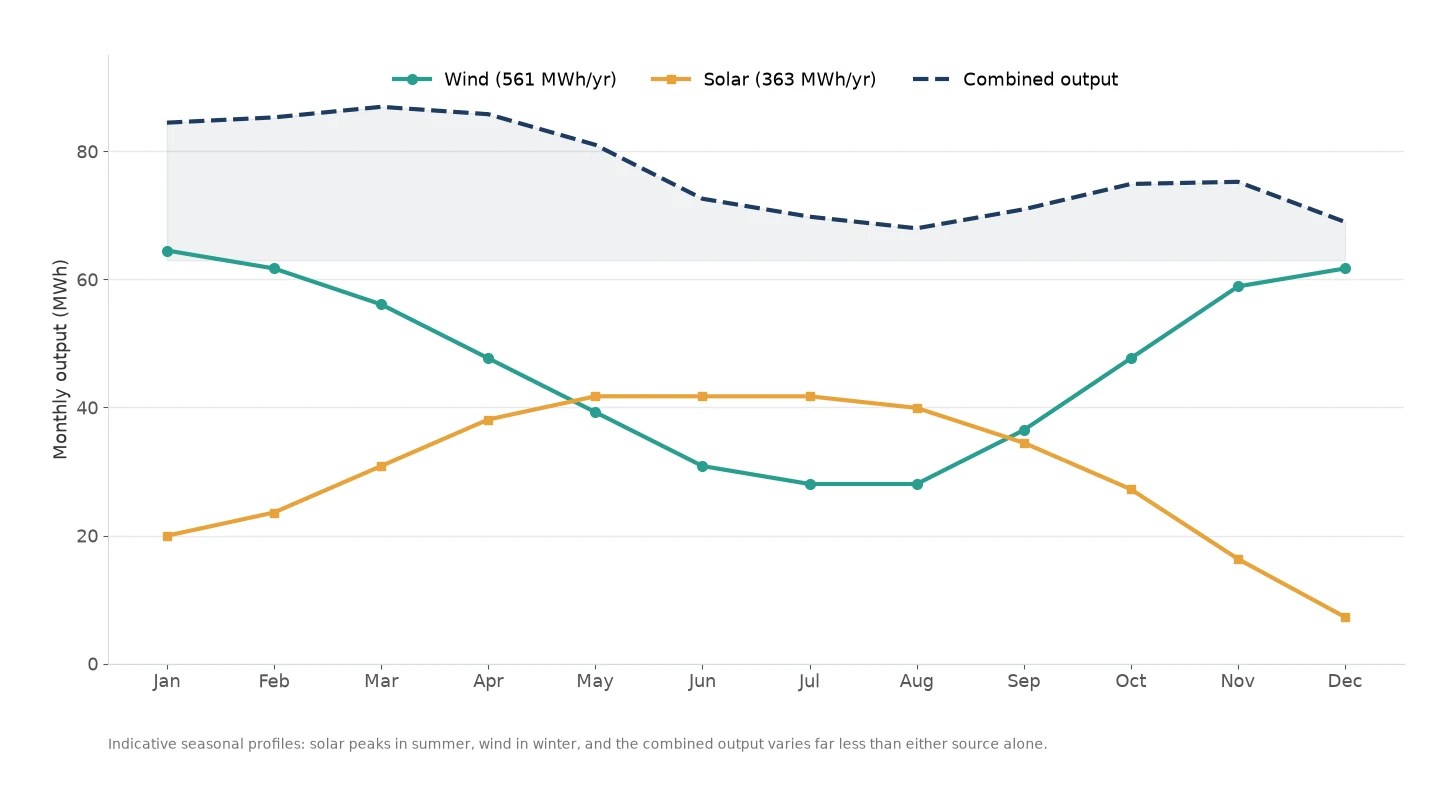
Storage does not solve a seasonal problem. A battery sized for daily cycling is empty every morning; it cannot carry energy from a windy March into a calm July. The seasonal balance is solved by designing the annual energy margin and by accepting that the generator covers the residual in the worst month. What the hybrid does is reduce the size of that residual and the number of hours the generator runs at low load.
That last point matters more than it looks. A diesel generator running at 20% load burns fuel per kilowatt-hour at two to three times its rated consumption, and it wears faster. Keeping the generator above its minimum load is an operational requirement, and a wind addition that fills the shoulder months reduces the number of hours the generator spends below it.
Rectifiers, inverters and the AC coupling decision
A small wind turbine generates variable-frequency, variable-voltage AC, and that output has to be converted before it can join a system.
Modern small and medium turbines use a permanent-magnet synchronous generator with a full-power converter: the generator’s AC is rectified to DC, then inverted to grid-quality AC at a fixed frequency and voltage. The turbine therefore presents itself to the system as an AC source with a controllable power factor, much like a PV inverter.
That similarity makes the coupling choice simpler than it once was, but it is still a real design decision.
| Coupling | How it works | Strength | Weakness |
|---|---|---|---|
| AC coupling | Turbine and PV each connect through their own grid-tied inverters to a common AC bus; battery through a bidirectional inverter | Components are standard; easy to expand and to isolate faults | Multiple conversions; grid-forming control must come from one unit |
| DC coupling | Turbine and PV rectified to a common DC bus, one bidirectional inverter for the whole system | Fewer conversions; single point of control | Non-standard for turbines; a converter failure takes down the whole bus |
| Hybrid | Turbine AC-coupled, PV and battery DC-coupled | Balances standard equipment with efficiency | More complex protection coordination |
For systems in the 50 kW to 1 MW band, AC coupling is the default because every component is a standard product with standard protection. The one requirement that cannot be left vague is which device forms the voltage and frequency reference in island mode. In a grid-tied installation the grid does it; in an off-grid system one inverter must be grid-forming, and the rest must follow. If two units both try to form the grid, the system will fight itself.
Weak-grid sites add a second requirement: the system has to ride through voltage and frequency disturbances that a strong grid would never produce, and the turbine’s converter must not trip on the first dip.
Diesel backup still has a job in a wind hybrid
No wind-plus-storage system at this scale can be sold as diesel-free without a site-specific study that most projects cannot justify. The honest design includes a generator, sized for the residual after the renewable sources and the battery have done their work.
The generator’s size is set by two constraints. It must carry the site’s peak load with the battery contributing its rating, and it must run above its minimum stable load whenever it runs at all. A 200 kW generator at 25% load is consuming fuel at a rate that makes the renewable system look worse than it is.
| Scenario | Duration | What covers it |
|---|---|---|
| Normal night | 8–14 hours | Wind and battery |
| Two calm days | 2 days | Battery plus generator at moderate load |
| Week-long calm spell | 5–7 days | Generator as prime source; battery for peaks |
| Turbine maintenance | 1–3 days | Generator plus battery |
The 24/7 guarantee question has the same answer with wind as with solar: the guarantee comes from the generator, and the renewable share is what reduces its run hours rather than eliminating it.
Site screening: roughness, obstacles and turbulence

A turbine’s economics are decided before any equipment is specified, by whether the site has wind and whether that wind is clean.
Average wind speed. Below about 5 m/s at hub height, a small turbine rarely pays back. Between 5 and 6 m/s it depends on the diesel price it displaces. Above 6.5 m/s the case is usually strong.
Obstacle clearance. A building, a tree line or a ridge creates a wake that can extend ten to twenty times its height downwind. A turbine sited within that wake sees lower average speed and much higher turbulence, which shortens blade life. The rule of thumb is to place the turbine at least ten times the obstacle height away, and preferably upwind of it.
Turbulence intensity. High turbulence raises fatigue loads and can force a turbine to derate or shut down to protect itself. A site that looks windy on an annual average but sits behind a ridge or among buildings can have a turbulence intensity above 20%, which is enough to make a turbine’s effective output lower than the resource map suggests.
Access and foundations. A 100 kW turbine on a 30 m tower needs a crane or a tilt-up erection method, a foundation sized for the tower’s overturning moment, and a maintenance access route. On a remote site, the logistics can exceed the equipment cost.
Noise and setback. Small turbines are quieter than they used to be, but a site near accommodation still needs a setback that satisfies local rules. This is a planning constraint, not an engineering one, and it can rule out an otherwise good location.
Grid or island mode. A grid-tied turbine needs the utility’s approval and a protection scheme that includes anti-islanding. An islanded system needs grid-forming control and a load management strategy. The two are different designs, not variations of one.
Worked example: 200 kW wind, 300 kWp PV and 500 kWh of storage
The example below is a design sequence with the numbers left in. The site is a remote industrial facility with a mixed day and night load, a hub-height wind resource of 6.5 m/s and a solar resource of 1,550 kWh/m²/yr on the array plane.
Load. Annual consumption is 1,314 MWh. Average load is 150 kW, the daytime peak is 220 kW, and the night load is 120 kW for 11 hours.
Wind. A 200 kW turbine at 6.5 m/s hub-height wind, with a capacity factor of 32%, produces:
200 kW × 8,760 h × 0.32 = 560,600 kWh per year
Solar. A 300 kWp array with a performance ratio of 0.78 produces:
300 kWp × 1,550 kWh/m²/yr × 0.78 = 362,700 kWh per year
Combined renewable energy. The two sources together produce 923,300 kWh, or 70% of the site’s 1,314 MWh annual consumption. Because generation and load do not match in time, the delivered renewable share after storage and curtailment is about 62%, or 815 MWh.
Storage. A 500 kWh battery with 90% usable capacity covers the night gap when wind is below its average, absorbs midday surplus when wind and solar overlap, and holds the generator above its minimum load. It cycles once per day on most days.
Generator. The residual 499 MWh is supplied by a 250 kW diesel generator, which runs about 3,200 hours a year at an average load of roughly 62%. That load factor is above the minimum stable load, which is what keeps the engine healthy and the fuel consumption per kilowatt-hour reasonable.
Fuel. At 3.5 kWh per litre, the diesel requirement is about 143,000 litres a year. A diesel-only site of the same load would burn roughly 375,000 litres, so the hybrid saves about 232,000 litres annually.

The configuration is deliberately not “half wind, half solar”. Wind carries 61% of the renewable energy because the site’s gap is at night and in winter; solar carries 39% because it is cheaper per installed kilowatt and covers the daytime peak. The ratio came out of the hourly match, not out of a design habit.
Protection and interconnection for small wind
A wind turbine adds protection requirements that a PV system does not have, and they are the part of the design most often left to the end.
| Requirement | Why it exists | What it means in practice |
|---|---|---|
| Anti-islanding | The turbine must stop feeding a de-energised grid | A relay that detects loss of mains within the required time |
| Over-speed and braking | A turbine that loses its load can overspeed | Mechanical brake plus aerodynamic braking, tested at commissioning |
| Voltage and frequency ride-through | The turbine must not trip on a transient the grid can ride through | Converter settings agreed with the utility |
| Reactive power capability | The connection point has a power factor requirement | A converter rating that leaves margin for reactive output |
| Lightning and surge protection | Blades and towers are exposed | Earthing system and surge arresters on the DC and AC sides |
| Condition monitoring | Rotating machinery fails progressively | Vibration and temperature monitoring, with alarm thresholds |
A wind, solar, storage and diesel system has to coordinate all of these with the PV inverters, the battery inverter and the generator controller. The protection study is the document that proves the coordination works, and the utility will ask for it before it allows the turbine to connect.
In an islanded system the equivalent document is the dispatch and load management design: what happens when the wind rises above the load, how the dump load or curtailment engages, and how the generator is brought in without a voltage dip. The battery’s inverter is usually the grid-forming unit, and its rating has to cover the largest step load the site can produce.
Wind is a design decision, not a product
A wind turbine added to a 50 kW to 1 MW power system is worth building when it covers a gap the other sources cannot, at a site with clean wind and a tower tall enough to reach it. It is not worth building because wind sounds greener than diesel, and it is not worth building at a ratio chosen in advance.
The design sequence that works is short: measure the load by hour, measure the wind at hub height over at least a year, size the turbine to the gap, size the battery to the variability the turbine introduces, and keep a generator sized for the residual. Every one of those steps is arithmetic, and none of them depends on a manufacturer’s data sheet.
The same staged approach applies to mining and industrial sites where the load changes over the life of the project: build in modules, state the expansion path, and revisit the wind resource as the load grows. Send the load profile and the wind data, and the sizing follows.
FAQ
– Q: What average wind speed do I need for a small wind turbine to be worthwhile? A: About 5.5 m/s or more at hub height for a grid-tied system, and 6 m/s or more where the alternative is diesel. Below 5 m/s the capacity factor is usually too low to justify the maintenance burden.
– Q: Can a small wind turbine run without a battery? A: Not usefully. Wind output fluctuates on a timescale of seconds to hours, and without storage the turbine either spills energy or leaves the load short. The battery is what turns a variable source into a usable supply.
– Q: How much does a 100 kW wind turbine cost? A: Indicatively USD 250,000 to 400,000 for the turbine, tower and foundation, before installation logistics and grid connection. Remote sites can double the installed cost through crane access and transport.
– Q: How do I combine wind and solar in one system? A: AC-couple both to a common bus behind a single grid-forming inverter, with the battery on the same bus. Keep each source’s protection independent, and let one controller dispatch the battery against the combined renewable output.
– Q: What happens during a week without wind? A: The battery covers the first day, then the generator runs as the prime source. The system has to be designed so that this state is normal, not an emergency: the generator must be sized for it and the fuel supply must cover it.
YURI POWER Engineering Team · November 20, 2026