
A temporary power plant is not a small permanent one. It is an asset that arrives on a truck, runs for eighteen months and leaves again, and every design decision should be judged against that journey rather than against the cost per kilowatt-hour of a twenty-year installation.
Most temporary power plants are nevertheless designed as if they were permanent. The generator is sized for a peak that the site never actually reaches, the distribution is buried in trenches that have to be dug up at demobilisation, the solar array is mounted on concrete ballast that cannot be reused, and the storage is specified with a cycle-life warranty the project will never approach. The plant works, and then it costs as much to dismantle as it did to build.
This guide covers temporary power systems for construction sites from 50 kW to 1 MW: the phasing of construction loads, the generator sizing rules that account for motor starts, what equipment travels well, the rental-versus-purchase break-even, fuel logistics, and a worked example of a 300 kW site over eighteen months.
A temporary plant is designed to move, not to last
A permanent plant optimises lifecycle cost. A temporary plant optimises the cost of delivering power for a defined period plus the cost of leaving.
Those are different objective functions, and they produce different answers. The permanent plant buys the most efficient generator because it will run for twenty years. The temporary plant may buy a cheaper, less efficient unit, because the efficiency difference over eighteen months is smaller than the cost of moving a heavier machine twice.
| Design question | Permanent plant answer | Temporary plant answer |
|---|---|---|
| What decides the generator size? | Continuous load plus growth margin | Peak starting current, with the smallest unit that covers it |
| How is distribution installed? | Buried, permanent, code-compliant | Above ground, modular, recoverable |
| What foundation does PV need? | Ballasted or pile-driven, fixed | Skid or ground-screw, demountable |
| Where does the battery live? | Purpose-built room or container pad | Container on skids, moved as a unit |
| What is the design life? | 20–25 years | The contract duration plus one mobilisation |
| What matters at the end? | Residual value after depreciation | Residual value after two moves |
The single most useful number in a temporary power design is the number of moves the equipment will make. Equipment that moves once has different requirements from equipment that will follow a contractor from site to site for a decade. A containerised system that is designed for repeated lifting, with lifting points, fork pockets and connectorised cabling, costs more to buy and less to own.
A mining project’s construction phase is the clearest example: the camp and the construction loads are temporary even though the mine is not, and the equipment that serves them usually moves to the next project when the plant is commissioned.
The load arrives in phases, not as a profile
A permanent site has a load profile. A construction site has a load schedule, and the schedule is driven by the works programme rather than by the weather or the shift pattern.
Four phases dominate, and each has a different electrical signature.
| Phase | Typical duration | Typical load | What dominates |
|---|---|---|---|
| Earthworks and civil | 20–35% of programme | 50–150 kW | Excavators, pumps, dewatering, site offices |
| Structure and steel | 15–25% | 100–250 kW | Cranes, welding sets, compressors, lighting |
| Mechanical and electrical installation | 25–35% | 150–350 kW | Hoists, temporary HVAC, testing equipment |
| Commissioning and handover | 5–15% | Falls to 50–100 kW | Load banks, instrumentation, cleaning |
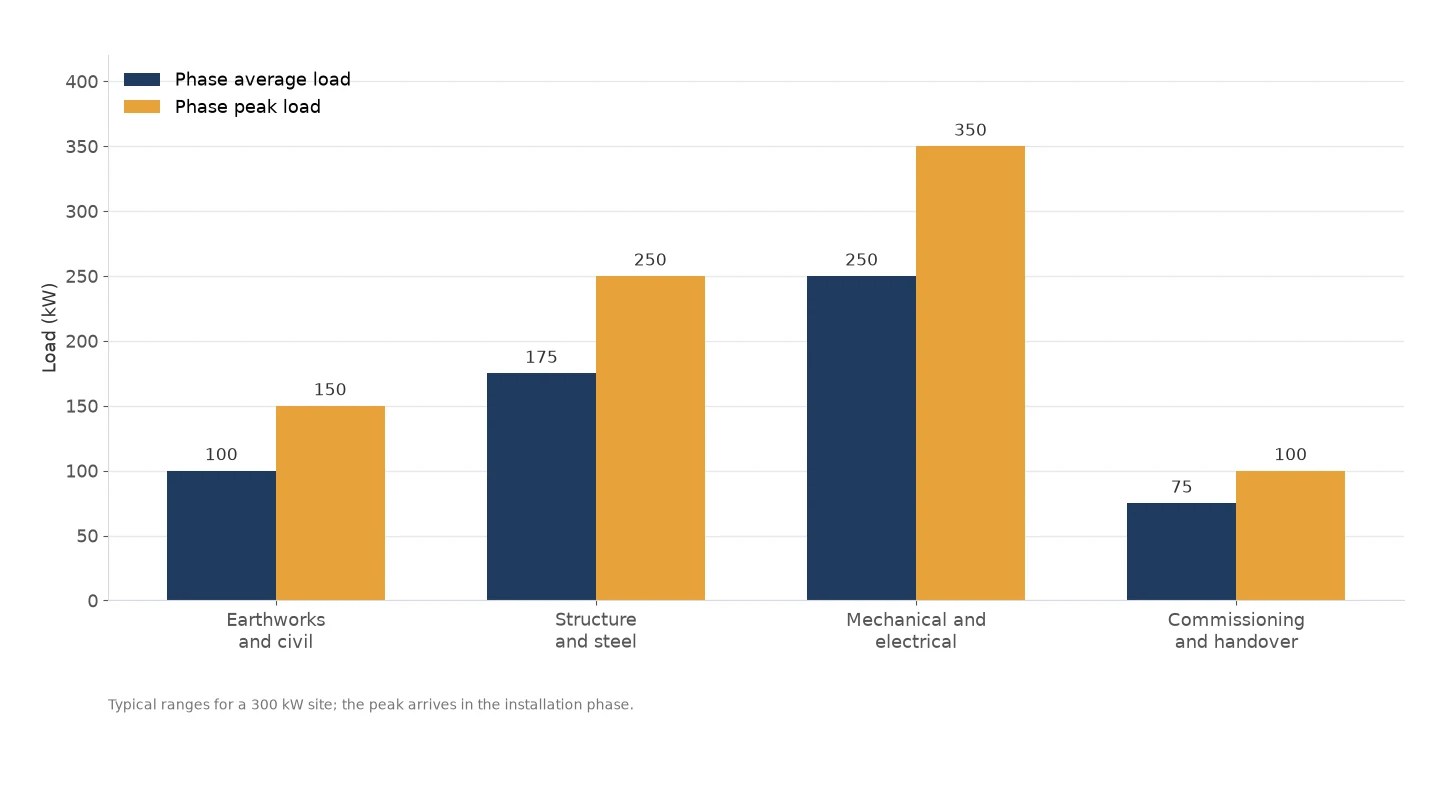
The peak usually arrives in the third phase, when installation crews and testing equipment overlap, and it is usually 50 to 100% higher than the average of the whole programme. A plant sized for the average is undersized exactly when the site needs it most.
Because there is no historical interval data for a site that does not exist yet, the load is estimated from the equipment list. The method is straightforward: list every significant load, multiply its rated input by a utilisation factor for each phase, sum the results, and apply a diversity factor for equipment that will not run simultaneously.
| Equipment | Rated input | Utilisation | Diversity | Design load |
|---|---|---|---|---|
| Tower crane | 60 kW | 40% | 1.0 | 24 kW |
| Welding sets (6) | 12 kW each | 30% | 0.7 | 15 kW |
| Compressors (2) | 22 kW each | 60% | 0.8 | 21 kW |
| Dewatering pumps (3) | 15 kW each | 80% | 0.9 | 32 kW |
| Site offices and lighting | 30 kW | 90% | 1.0 | 27 kW |
| Hoist and small tools | 45 kW | 50% | 0.7 | 16 kW |
The sum of the design loads, 135 kW, is the average demand for that phase. The peak is higher, and the generator must cover the peak plus the starting current of the largest motor.
Diesel is the base case — here is when solar changes it
For a construction site, diesel is the default because it is deployable in days, scalable by adding units, and removable at the end. Solar and storage change the economics only when the project is long enough for the fuel saving to repay equipment that has to be mobilised and demobilised.
The arithmetic is simple. A 100 kWp PV array on a site with good irradiance produces about 150 MWh a year. On a construction site most of that production is consumed on site, because the load runs through the working day, so the fuel saving is roughly 43,000 litres a year at 3.5 kWh per litre.
At a delivered diesel price of USD 1.20 per litre, that is about USD 51,600 a year. A containerised 100 kWp PV system with skid-mounted arrays, grounding and connection hardware indicatively costs USD 70,000 to 90,000 delivered, plus mobilisation and demobilisation.
| Project duration | PV fuel saving | PV net cost after residual value | Verdict |
|---|---|---|---|
| 6 months | USD 26,000 | USD 55,000 (60% residual) | Not justified on fuel alone |
| 12 months | USD 52,000 | USD 45,000 (50% residual) | Marginal |
| 18 months | USD 77,000 | USD 34,000 (40% residual) | Justified |
| 24 months | USD 103,000 | USD 21,000 (30% residual) | Clearly justified |
| 36 months | USD 155,000 | Negative — asset fully paid | Strong |
The table assumes the array remains productive across moves, which depends on the mounting system. A skid-mounted array that is designed to be lifted and re-levelled survives a move; a ballasted array that has to be disassembled bolt by bolt generally does not.
Generator selection also changes once PV is present. The generator can be smaller, because PV carries the daytime base load, but it must still cover the peak and the starting currents, and it must run above its minimum load when PV is low.
Size the generator for motor starts, not average load
The generator’s rating is set by two numbers, and the larger one wins: the continuous load the site needs, and the largest motor start the site can produce.
A direct-on-line induction motor draws four to seven times its rated current for the few seconds it takes to accelerate. A 75 kW motor starting across the line on a 200 kW generator can pull the voltage down by 15 to 25%, which trips contactors, resets controllers and, on some equipment, stalls the motor itself.
The rules that keep this manageable are well established:
Start the largest motor first. Sequence the site so that the biggest load starts when nothing else is running. This is free and it is usually enough.
Use soft starters or variable-frequency drives. A soft starter reduces the starting current to two to three times rated; a drive can hold it near rated. The cost of a drive is often less than the cost of the next generator size up.
Check the voltage dip at the motor terminals. A dip of 10 to 15% is acceptable for most equipment; more than 20% is not. The calculation depends on generator subtransient reactance and cable impedance, and it should be done, not estimated.
Do not oversize for growth that will not happen. A construction site’s peak is known from the programme. Sizing for a peak that arrives in eighteen months wastes fuel for eighteen months.
| Largest motor | Generator size for DOL start | Generator size with soft starter | Generator size with VFD |
|---|---|---|---|
| 30 kW | 100 kW | 75 kW | 60 kW |
| 55 kW | 160 kW | 125 kW | 100 kW |
| 75 kW | 220 kW | 160 kW | 125 kW |
| 110 kW | 320 kW | 250 kW | 200 kW |
The table is a screening guide; the actual requirement depends on the motor’s starting torque, the load it drives and the generator’s characteristics. But the direction is consistent: the starter, not the generator, is usually the cheaper fix.
Containerised PV and storage: what travels well
Temporary power equipment is bought for its second use as much as its first, so the question is not only “does it work here” but “does it survive the move”.
| Equipment | Travels well? | Why |
|---|---|---|
| Containerised BESS | Yes | Lifting points, integrated cooling and fire suppression, connectorised cables |
| Skid-mounted PV arrays | Yes, if designed for it | Pre-assembled frames and quick connectors; re-levelling on new ground |
| Ballasted PV on concrete blocks | No | Blocks are heavy, broken in transit and rarely reusable |
| Ground-screw PV | Partly | Screws can be extracted but are often damaged; frames are reusable |
| Containerised generator | Yes | Standard ISO footprint, fuel tank integral, easy to lift |
| Skid-mounted generator | Yes | Lighter, but needs a trailer or crane for each move |
| Buried LV distribution | No | Cable is destroyed on recovery, trenches are re-excavated |
| Overhead temporary distribution | Yes | Poles, brackets and cable are all recoverable |
| Fixed switchgear in a building | No | Cannot be removed without demolition |
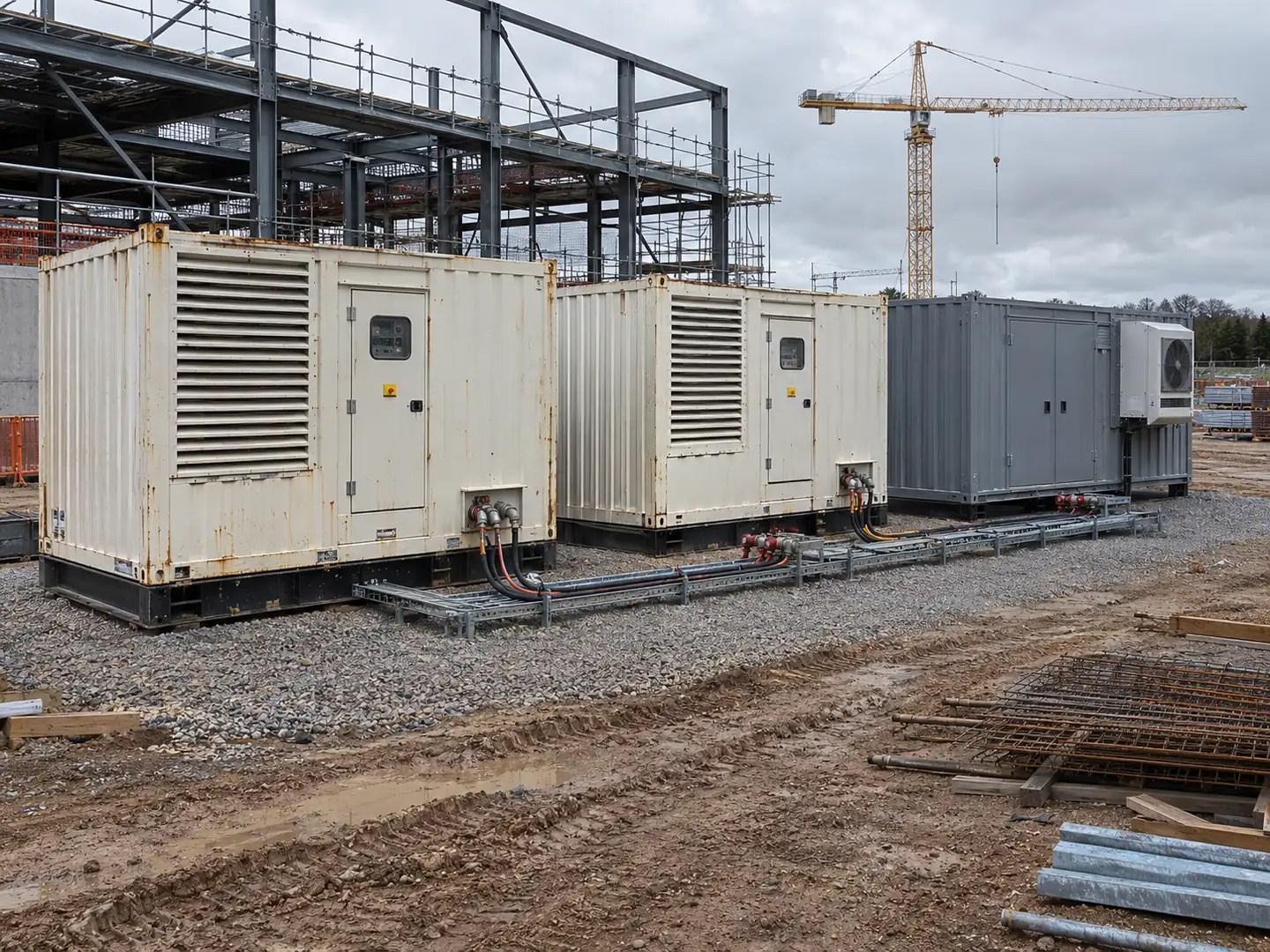
The rule that follows is simple: anything that touches the ground permanently should be avoided, and anything that lifts as a unit should be preferred. A containerised battery and a skid-mounted PV array are the two formats that satisfy both tests, which is why they dominate temporary hybrid systems.
A containerised hybrid power station is designed around exactly this requirement: the generation, storage and control are in a format that arrives assembled and leaves assembled.
Rental vs purchase: the break-even is shorter than you think
Contractors assume rental is always cheaper for short jobs and purchase always cheaper for long ones. The break-even is usually shorter than the rule of thumb suggests, because purchase retains residual value.
Take a 250 kW generator. Rental at a typical rate of USD 3,500 a month costs USD 42,000 a year. Purchase at USD 55,000 plus USD 6,000 of mobilisation costs USD 61,000 up front, and after eighteen months a well-maintained unit is worth about 55% of its purchase price, or USD 30,000.
| Option | 18-month cost |
|---|---|
| Rental | USD 63,000 |
| Purchase, then sell | USD 61,000 − USD 30,000 = USD 31,000 |
| Purchase, then keep for next project | USD 61,000, with an asset worth USD 30,000 |
The purchased unit is cheaper after about fourteen months, and dramatically cheaper if the contractor has a second project to move it to. Rental wins only when the job is short, the equipment is specialised, or the contractor has no maintenance capability.
The same logic applies to the battery and the PV array, with one caveat: the residual value falls faster for electronics than for generators, because battery capacity degrades and inverters date. A battery bought for an eighteen-month job and resold afterwards recovers maybe half its cost; the same battery moved to a second project keeps most of its value.
Fuel logistics decide the real cost
The diesel price on the invoice is not the price the site pays. The price the site pays includes getting the fuel to the tank.
| Monthly consumption | Tank size needed | Deliveries per month | Delivered cost premium |
|---|---|---|---|
| 5,000 L | 3,000 L | 2 | 5–10% |
| 15,000 L | 10,000 L | 2 | 5–10% |
| 30,000 L | 20,000 L | 2 | 10–15% |
| 50,000 L | 30,000 L | 2–3 | 15–25% |
Remote sites pay more per litre for the same reason they pay more for everything: the last fifty kilometres are the expensive ones. A site 300 km from the nearest fuel depot can see a delivered premium of 15 to 25% over the depot price, and that premium is applied to every litre the generator burns.
Two design decisions reduce it. The first is tank capacity: a tank that needs a delivery every week is more expensive per litre than one that needs a delivery every month, because delivery charges are per trip. The second is generator efficiency at part load: a 250 kW generator running at 30% load burns fuel at a rate per kilowatt-hour that is 30 to 50% worse than at 70% load, and the premium is applied to the worse number.
Matching generator size to load is therefore a fuel logistics decision as much as an electrical one. A smaller generator running at a good load factor, with the battery covering peaks, burns less fuel than a larger one running lightly loaded.
Earthing, cabling and temporary distribution
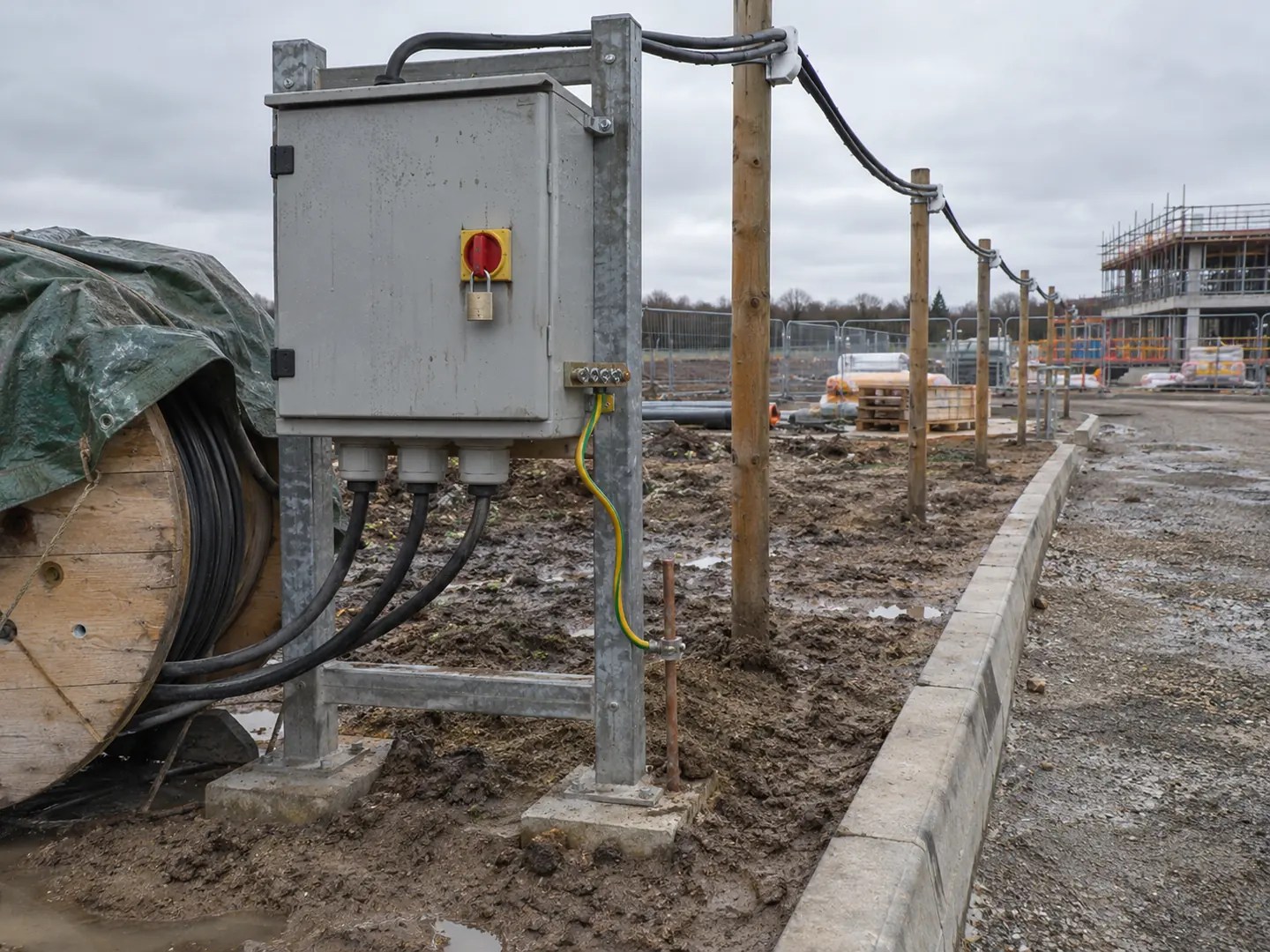
Temporary distribution is where safety and recoverability meet, and the two requirements are usually satisfied by the same choices.
Earthing. A temporary installation needs a reliable earth reference at every distribution point. Earth electrodes are driven at each main board and bonded to the generator’s neutral point according to the site’s earthing arrangement. The arrangement must be documented, because a temporary system that changes as the site grows will otherwise end up with a mix of earthed and floating sections.
Cable routes. Overhead distribution on poles or brackets is recoverable and keeps cable out of excavation zones. Where cable must cross a road, a protected crossing is cheaper to maintain than a buried duct that will be cut by the next excavator.
Protection. Residual current protection at distribution boards, correct discrimination between upstream and downstream devices, and a lockable isolation point at every board. Temporary boards are often moved, so the protection settings must be simple enough to verify at each new location.
Segregation. Temporary distribution should not share trenches, ducts or boards with permanent installation work. Mixing the two is the most common cause of an outage that takes a day to find.
A site survey before the plant is specified should record the cable routes, the earthing points and the access for each move, because those three items decide the demobilisation cost more than the equipment does.
Worked example: a 300 kW site over 18 months
The example below is a temporary power design for a construction site with an eighteen-month programme, a 300 kW peak in the installation phase and an average load of 180 kW.
Load. Total energy over the programme is about 2.37 GWh, based on the programme’s phase durations and the equipment list.
Generator, diesel only. Two 200 kW containerised generators, one running and one standby, cover the peak and the largest motor start. At an average load of 70%, fuel consumption is about 0.24 litres per kWh, so annual consumption is:
2.37 GWh × 0.24 L/kWh = 569,000 litres over the programme
At a delivered price of USD 1.20 per litre, fuel costs USD 683,000.
Generator, diesel plus PV. A 100 kWp skid-mounted array produces about 225 MWh over eighteen months, of which 90% is consumed on site, displacing about 58,000 litres and USD 70,000 of fuel. The generator still covers the peak and the night load, so it stays the same size, but its average load factor rises because PV carries the daytime base.
Capital. The PV system costs about USD 80,000 delivered and installed, and recovers about 40% of that at demobilisation, or USD 32,000. Net cost is USD 48,000 against USD 70,000 of fuel saved, a net benefit of USD 22,000.
Battery. A 200 kWh containerised battery costs about USD 85,000 and recovers 50% at demobilisation. Its main value is reducing generator run hours at night and during the shoulder phases, which saves fuel and maintenance but rarely pays for itself on an eighteen-month programme. In this example it is included only if the site has a reliability requirement that the generator alone cannot meet.
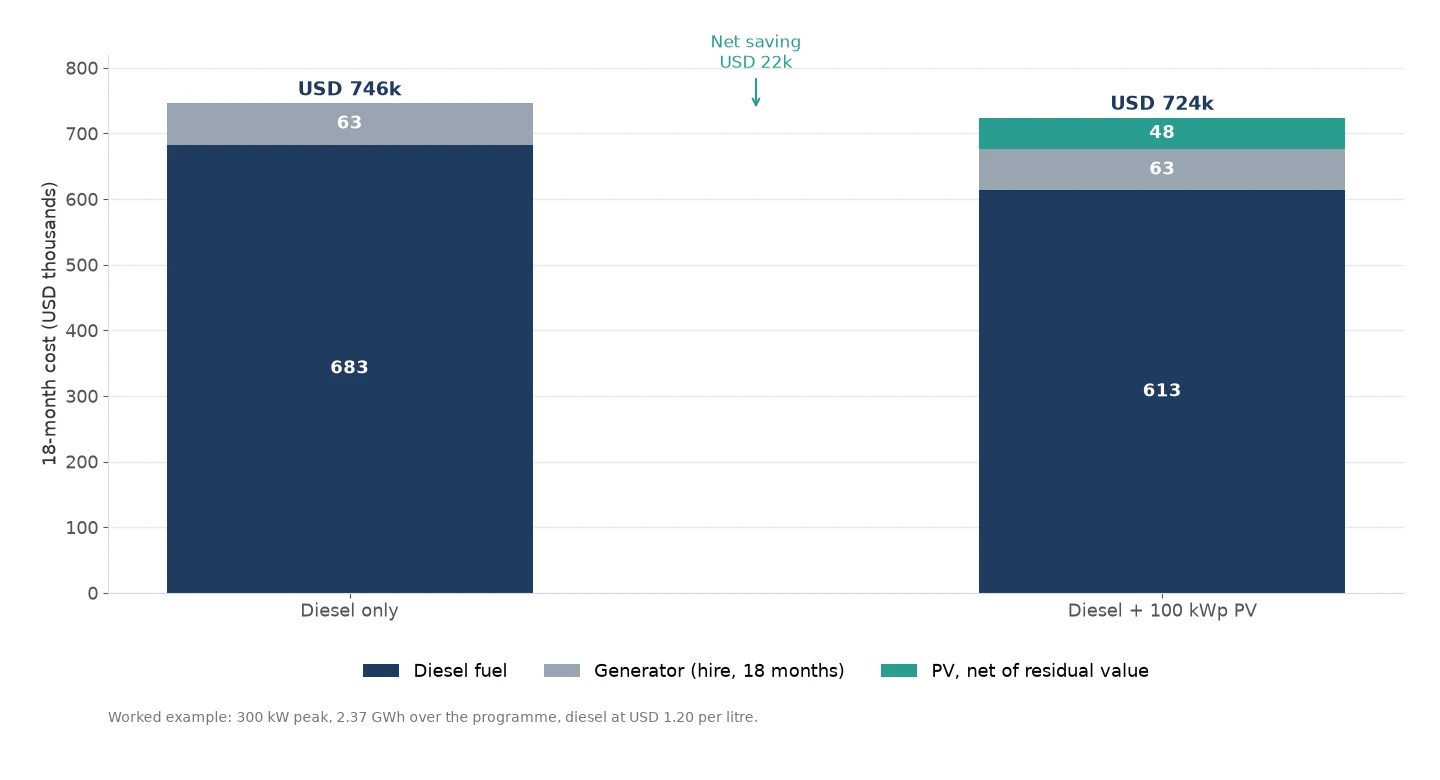
Total. The diesel-only option costs about USD 683,000 in fuel plus generator rental or ownership. The hybrid option costs about USD 48,000 more in net capital and USD 613,000 in fuel, a net saving of about USD 22,000 over the programme. The saving is real but modest, and it grows with every month the project runs beyond eighteen.
Demobilisation: what the asset is worth when the job ends
The demobilisation plan should be written before the equipment is bought, because it decides what can be bought.
| Asset | Typical residual after 18 months | What preserves value |
|---|---|---|
| Containerised generator | 55–65% | Maintenance records, low hours, clean fuel system |
| Containerised BESS | 45–60% | Cycle count, state of health report, warranty transferability |
| Skid-mounted PV | 40–60% | Frame condition, connector wear, inverter age |
| Transformers and switchgear | 50–70% | Test certificates, corrosion protection |
| Cabling and distribution | 30–50% | Cable condition, connector type, recovery labour |
Three practices protect residual value more than any other. Keep the maintenance records with the asset, because a buyer pays for evidence. Keep the original packaging and lifting equipment, because a move without them damages more equipment than the move itself. And design the connection points for disconnection, because a system that has to be cut apart at demobilisation leaves the site with scrap rather than assets.
Temporary power is a logistics problem with an electrical solution
A construction site from 50 kW to 1 MW is served best by equipment that is sized to the phase peaks, protected against motor starts, mounted so it can leave, and costed over its whole journey rather than its first location.
The design sequence follows from that: estimate the load phase by phase from the equipment list, size the generator to the peak and the largest motor start, decide the rental or purchase question against the programme length, add PV only when the duration pays for the mobilisation, and write the demobilisation plan before placing the order.
Containerised power systems exist because this sequence is common, not exceptional. Send the works programme and the equipment list, and the sizing follows from the phases rather than from a rule of thumb.
FAQ
– Q: How much does temporary power cost for a construction site? A: Fuel dominates. A 300 kW site running for eighteen months spends roughly USD 680,000 on diesel, against USD 60,000 to 100,000 for generator hire. Solar can displace 10 to 15% of the fuel on a programme of that length.
– Q: Can I use solar on a construction site? A: Yes, if the array is skid-mounted and the project runs longer than about fifteen months. Shorter projects rarely recover the mobilisation and demobilisation cost.
– Q: What size generator do I need for a construction site? A: Size for the phase peak plus the largest motor start, not the average load. A soft starter or a variable-frequency drive often reduces the required generator size by one step.
– Q: How long does it take to set up temporary power? A: Two to four weeks for a containerised plant up to 300 kW, including foundations, cabling and commissioning. A site that needs a new transformer or a utility connection takes longer.
– Q: What happens to the equipment when the project ends? A: It moves, sells or returns to the rental company. Containerised and skid-mounted equipment typically recovers 45 to 65% of its purchase price after eighteen months, which is why the format matters as much as the specification.
YURI POWER Engineering Team · November 21, 2026