
Most mining microgrid guides are written as if a mine were a building. It is not. A mine is a project with a beginning, a middle and an end, and its power demand changes shape at every stage. The microgrid built in year one is asked to serve a different site by year four.
That is the reason so many mining microgrids end up oversized in some years and short in others. The design was correct for the load that existed when the proposal was written. Nobody planned for the load that came next.
This guide covers mining microgrids from 50 kW to 1 MW — the range that carries exploration camps, dewatering, crushing circuits and small to mid-size processing plants. It is the range we build and supply most often, and it is the range where the decisions are still close enough to get wrong by a factor of two.
If you already know the size and want the configuration, the mining microgrid page covers the system architecture. This article is about the reasoning that comes before it.
A mining microgrid is not one system
Four kinds of load show up on mining sites, and they behave nothing alike. Sizing any of them with the assumptions of another produces a system that either cannot carry the load or cannot pay for itself.

| Site type | Typical average load | Load shape | What decides the design |
|---|---|---|---|
| Exploration camp | 50–200 kW | Night-heavy; lighting, air-conditioning, water pumps | Battery hours, generator noise, fuel delivery |
| Dewatering and pumping | 100–800 kW | Continuous, seasonal, often remote from the plant | Uptime, restart after outage, no diesel access |
| Crushing and screening | 300 kW–several MW | Day-heavy, with large motor starting currents | Peak capacity, voltage dip on start, inverter overload |
| Processing and leaching | 500 kW–tens of MW | Flat, round-the-clock, 24/7 | Baseload energy, generator loading, grid stability |
The camp is a solar and battery problem: the load is small, it peaks after dark, and the value is in not hauling diesel. The crusher is an electrical problem: a 250 kW motor starting across the line draws four to six times its rated current for a few seconds, and a hybrid system that was sized on average load will trip. The processing plant is a capacity problem, and at that scale the question stops being “how much solar” and becomes “how much of the year can the generator be off”.
The shift toward hybrid mining power is real, but it looks different at 80 kW than it does at 8 MW.
The load changes four times in a mine’s life
This is the part that most proposals leave out, and it is the single largest source of error in mining microgrid design.
| Stage | Typical duration | Load range | What dominates |
|---|---|---|---|
| Exploration | 1–3 years | 50–200 kW | Camp, drilling, sample prep |
| Construction | 2–3 years | 200–500 kW | Temporary power, concrete, lifting |
| Operation | 5–20 years | 500 kW to several MW | Crushing, conveying, dewatering, processing |
| Closure and reclamation | 1–3 years | Falls to 50–100 kW | Pumping, monitoring, site care |
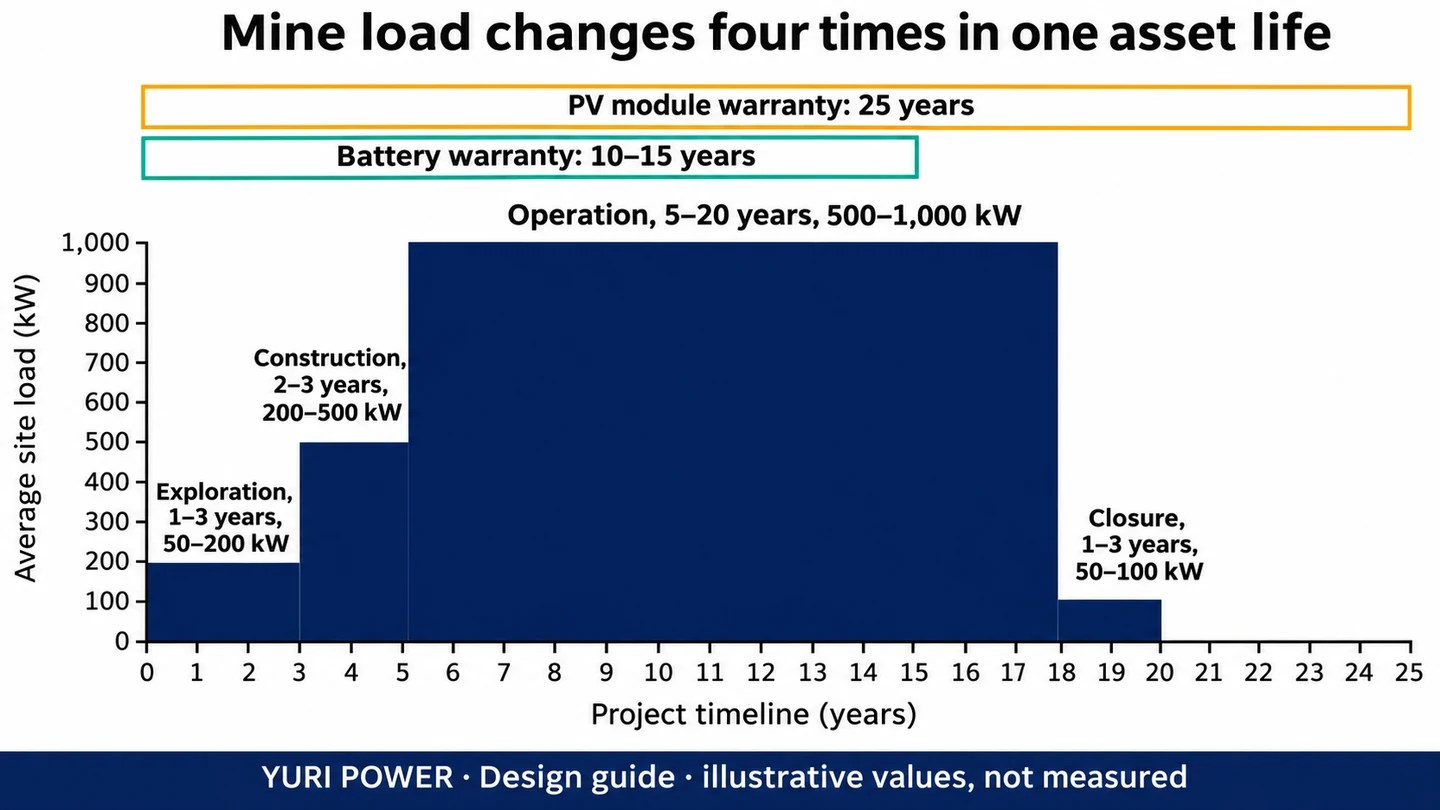
A PV module is warranted for 25 years. A battery is warranted for 10 to 15. A microgrid built at the exploration stage is expected to serve through construction, operation and closure — at least three different loads, and in the case of a small mine, four.
If the system is sized to the exploration camp, it is undersized the moment construction begins. If it is sized to operation, most of the capital sits idle for the first five years, and the camp still burns diesel. Neither is a design error in the narrow sense. Both are errors in the sense that matters: nobody asked what the load would be in year four.
There is a defensible answer, and it is not “build for the biggest stage”. It is to build in modules and to state the expansion path in the proposal — which is what the last part of this guide is about.
Four architectures, and what each one is for
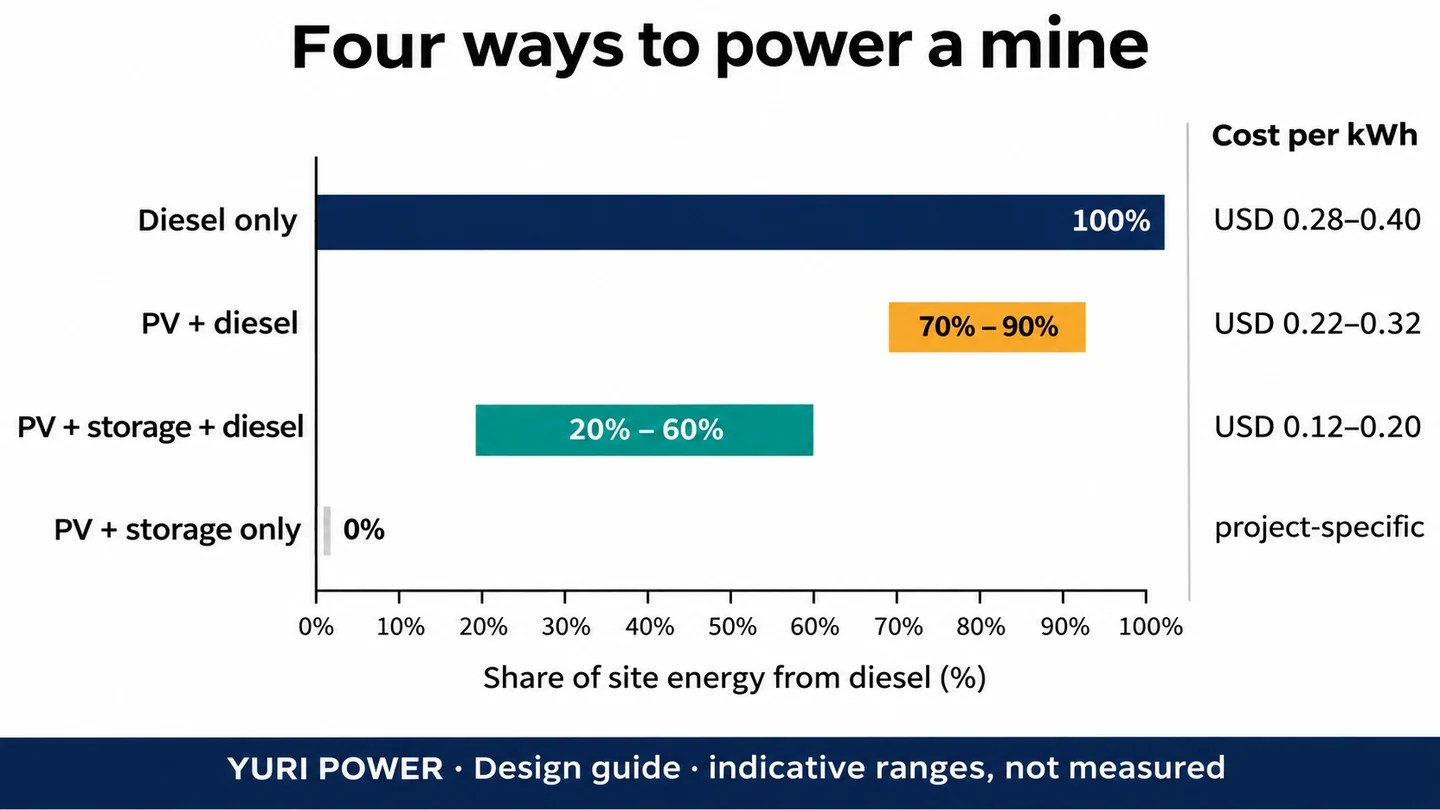
There are four ways to supply a mining site, and the choice is driven less by cost per kilowatt than by what the site can physically support.
| Architecture | Diesel share | Fits when | Main weakness |
|---|---|---|---|
| Diesel only | 100% | Short project, no land for PV, no budget for storage | Cost per kWh of roughly USD 0.28–0.40 and rising |
| PV + diesel | 70–90% | Existing gensets in good condition, tight capital budget | Diesel runs at low load; PV output is curtailed at midday |
| PV + storage + diesel | 20–60% | Most mining sites with a multi-year horizon | Control complexity; generator loading must be managed |
| PV + storage only | 0% | Diesel delivery impossible, or a no-diesel mandate | Large array and battery; high capital cost |
The third row is where most projects land, and it is the hardest to specify well. A PV and storage system without a generator has one operating mode and a clear sizing rule. Add a generator and the system acquires three sources, a dispatch strategy, a minimum-load constraint and a failure mode for each.
How much generator a hybrid microgrid should keep is a sizing question with an operational answer: the generator should be small enough that it never runs at low load for long, and large enough to carry the site’s starting currents.
The economics behind the shift are well documented. Reported results from hybrid mining projects put electricity cost at USD 0.12–0.16 per kWh against the diesel range of USD 0.28–0.40, and Caterpillar’s Tucson proving ground cut monthly fuel use from more than 500 gallons to under 25 by displacing continuous generation. A Zimbabwe mining microgrid of 11 MW PV, 30 MWh of storage and 4 MW of diesel backup supplies more than 85% of its power from solar and storage. Those numbers come from projects far larger than 1 MW, but the mechanism is identical, and the same mechanism is why a 500 kW camp can cut diesel by half.
What 50 kW, 200 kW, 500 kW and 1 MW each look like
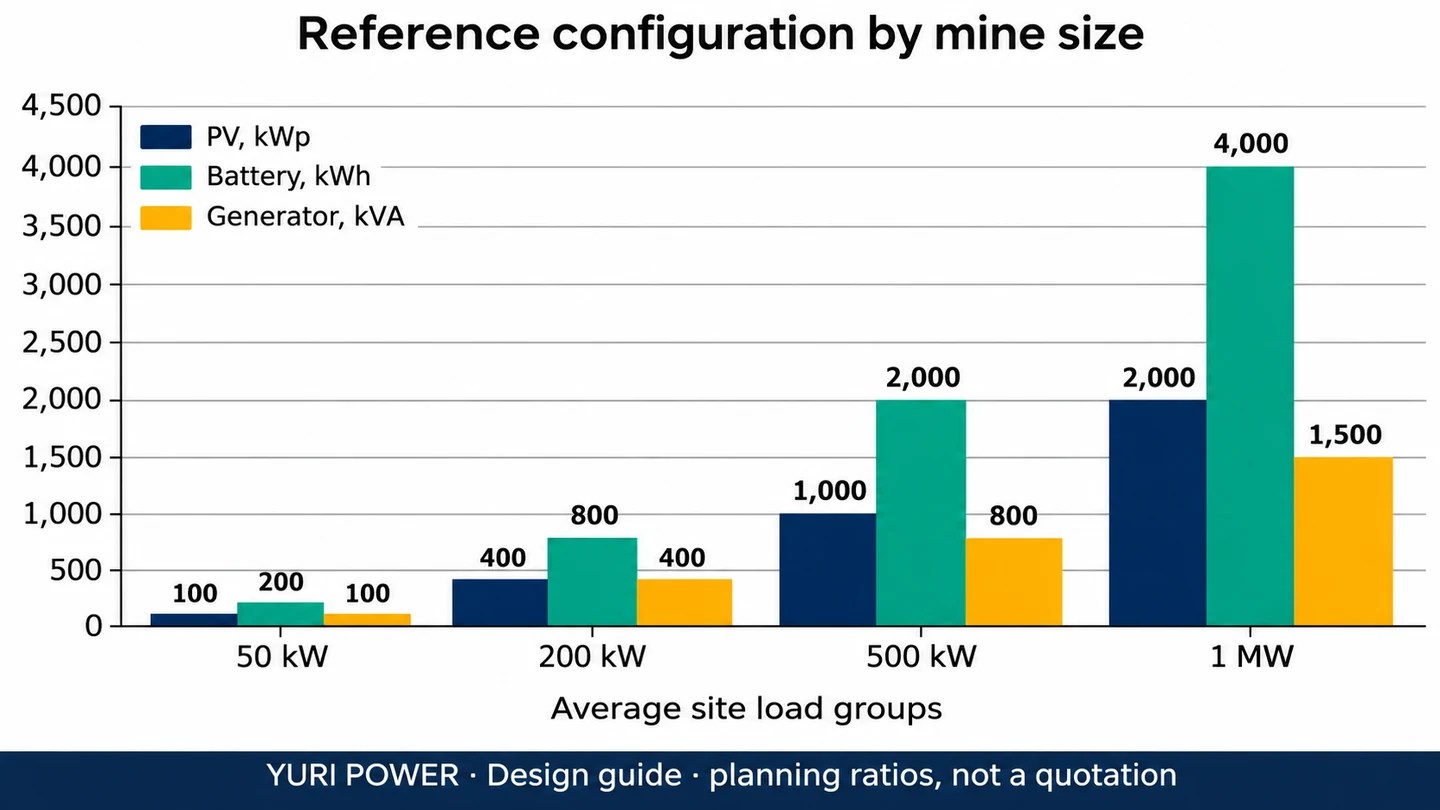
The table below is a starting point, expressed as ratios rather than fixed numbers. Every site differs in solar resource, load shape and fuel price, so treat these as the configuration a design conversation begins from, not a quote.
| Average load | PV | Battery | Generator | Typical renewable share |
|---|---|---|---|---|
| 50 kW | 100 kWp | 200 kWh | 100 kVA | 40–60% |
| 200 kW | 400 kWp | 800 kWh | 400 kVA | 40–60% |
| 500 kW | 1,000 kWp | 2,000 kWh | 800 kVA | 45–65% |
| 1 MW | 2,000 kWp | 4,000 kWh | 1,500 kVA | 45–65% |
Two ratios sit behind that table. PV capacity in kWp is roughly one to one and a half times the average load in kW, and battery capacity in kWh is roughly three to four hours of average load. Both are modest by off-grid standards, and both are deliberately so: the generator is carrying the residual, which is what keeps the array and the battery affordable.
A fully off-grid system at these loads would need two to three times the PV and four to eight times the battery, because it would have to survive a multi-day overcast period with no generator at all. That is the subject of a separate sizing exercise, and at the 1 MW end it is rarely the right answer for a mine that already owns diesel capacity.
The comparison point is the reference configuration on our mining microgrid page: 1.2 MW of PV with 4 MWh of storage at 2,400 m altitude, with a reported payback of two to four years. Note the ratio — 4 MWh against 1.2 MW is about three and a third hours of average load, exactly the range in the table above.
The generator has three jobs, and “backup” is the hard one
In a diesel-only mine, the generator is the power source. In a hybrid mine it plays one of three roles, and the role determines how it should be specified.
| Role | Runs | Sizing basis | Failure it introduces |
|---|---|---|---|
| Prime | Continuously, most of the day | Continuous rating, derated for altitude and temperature | Fuel cost, wear, maintenance interval |
| Peak shaving | High-load windows only | Peak demand, with fast start and synchronising | Start reliability after long idle periods |
| Standby | Rarely, sometimes for months | Site load plus largest motor start | Wet stacking, battery and fuel degradation, failed first start |
The standby role is the one that goes wrong on real sites, and it goes wrong for a physical reason. A diesel engine that runs at less than about 40% of its rating for long periods does not reach operating temperature. Fuel and oil do not burn cleanly, carbon builds up on injectors and exhaust surfaces, and the engine that was supposed to start when the PV went down is the engine that fails.
Hybrid systems make this worse before they make it better. Solar and storage displace the generator’s daytime output, its load factor falls, and a unit that used to run at 70% now runs at 25% or not at all. The fix is not to add more generation. It is to specify a smaller unit, to enforce a minimum load with the battery absorbing the difference, and to run the generator deliberately for a period each month rather than letting it sit.
At scale, the industry answer is the battery: a Zimbabwe microgrid of 11 MW PV and 30 MWh of storage with 4 MW of diesel keeps the diesel at a fraction of site energy without leaving the engines idle for months. The same logic is behind the storage now going into mining sites across North Africa, where the battery is specified for daily cycling rather than for rare emergencies. At 500 kW the mechanism is identical, and the minimum-load setting on the EMS is what makes it work.
Five constraints mining sites add to a standard design
A standard commercial and industrial design assumes a clean, accessible, grid-connected building. A mine offers none of those.
Dust. Fine dust settles on heat sinks, clogs filters and bridges insulation. Inverter and battery enclosures on a mining site need higher IP ratings and a cleaning schedule that assumes monthly rather than annual maintenance, and the cooling design has to tolerate a partially blocked intake.
Heat. Battery capacity falls as ambient temperature rises, and the derating is not linear. A bank specified at 25°C delivers less at 40°C, and the nameplate figure a proposal quotes is almost always the 25°C one. The derating curve has to be applied before the battery size is fixed, not after.
Altitude. Above about 1,000 m, air density falls and both engines and inverters lose capacity. At 2,400 m the loss is roughly 20% to 25% for a naturally aspirated diesel and about 5% to 10% for an inverter. A design that ignores altitude is a design that will not meet its rating on the site it was built for.
Vibration. Blasting, haul trucks and crushers transmit ground-borne vibration into structures. Racking, cabinet anchors and battery module fixings need a specification that accounts for it, and a containerised unit needs a foundation that is not simply a concrete slab.
Unattended operation. Most mining microgrids are not staffed by electrical engineers. The system has to recover from a generator failure, a string fault or a communications loss without a person on site, and it has to report what happened when someone does arrive. That requirement shapes the EMS and the remote monitoring package more than any capacity figure.
Dust, heat and access are not edge cases on these sites. They are the normal operating condition.
Size for the module, not for the mine
The conclusion that follows from everything above is that a mining microgrid should be built in expandable modules, with the expansion path written down.
Four reasons, in order of how often they decide the outcome:
1. The load changes. A 200 kW camp becomes a 400 kW construction site in two years. Modular capacity means adding a unit, not replacing a system.
2. The capital is staged. Mining companies fund by stage, and a design that front-loads five years of unused capacity competes badly against one that can be built in phases.
3. The battery ages. A bank at 80% state of health in year 12 needs supplementing. Adding a module is cheaper and less disruptive than replacing the whole bank.
4. The site moves. Exploration and construction loads relocate. Containerised units can follow them; a fixed plant cannot.
Containerised power systems are the practical expression of this. A 500 kW unit that arrives complete, connects to a busbar and can be joined by a second unit eighteen months later is a different asset class from a fixed installation designed for a load that will not exist in year five.
The design document should state the module size, the maximum number of modules the site can accept, and the busbar and protection provisions for future units. If the proposal cannot answer “what happens when the mine doubles”, the design is incomplete regardless of how good the initial configuration is.
A 1.2 MW reference at 2,400 m
To make the ratios concrete, our mining microgrid reference describes a mid-tier gold mine at 2,400 m, operating continuously, moving from diesel-only supply to a hybrid system of 1.2 MW of PV and 4 MWh of storage, with a reported payback of two to four years. Whether a hybrid system at this scale counts as baseload supply depends on how the generator and the battery share the night.
Three things about that reference are worth reading carefully, because they show how the constraints interact.
The PV-to-load ratio is about one to one, which is lower than the 1.5:1 a lower-altitude site might use. At 2,400 m the array produces less for its nameplate and the generator carries more of the residual.
The battery is about three and a third hours of average load, which is short by off-grid standards and adequate for a site whose load is day-heavy and whose generator is available. The battery’s job is to move solar energy into the evening and to absorb load steps, not to carry the mine through a cloudy week.
The payback of two to four years comes from the diesel that the array and battery displace at a site where fuel has to be delivered to altitude. The same configuration at sea level with cheap, reliable fuel would pay back more slowly, and the reference explicitly notes that diesel consumption and delivered fuel cost depend on site load, solar resource and dispatch strategy.
Where 50 kW to 1 MW stops
This guide covers 50 kW to 1 MW for a reason, and the reason is not modesty.
Above roughly 1 MW, a mining power system changes category. It needs medium-voltage collection, multiple megawatt-scale converters, protection coordination across a network, a SCADA layer and a control room. The engineering questions become about fault levels, harmonics and grid-code compliance rather than about battery hours and generator loading. Those are real projects and real capabilities, and they are not what this article describes.
There is also a mismatch on the demand side. A remote mine asking for 20 to 50 MW is asking for a utility-scale plant, and a proposal that treats it as a large microgrid will be wrong in ways that are expensive to discover late. The honest response to that enquiry is to say so early.
Within 50 kW to 1 MW, the questions are answerable with a site visit, a load record and a solar resource estimate. Beyond it, they are answerable only with a full engineering study. Knowing which conversation you are in saves everyone time.
Six things to send before a design starts
In the order they change the answer:
1. Twelve months of fuel records, or electricity bills if the site is grid-connected. This establishes the energy actually consumed, which is usually not the number in the project brief.
2. A week of 15-minute interval load data. Fuel records give energy; only interval data gives the shape. The peak, the night load and the largest motor start all come from this file.
3. The process flow and ore type. A crushing circuit and a leaching circuit have different load shapes, different starting currents and different criticality. The equipment list is what tells a designer which one is being built.
4. The five-year production plan. This is the input that turns a single number into an expansion path. Without it, the design can only be correct for one stage.
5. Site conditions: altitude, temperature range, dust, available area and access. These set derating, enclosure specification, array layout and the cost of getting equipment to site.
6. Diesel supply: price, delivery distance and reliability. The economics of a hybrid system are entirely a function of what diesel costs at the site, delivered. A site paying a premium for fuel to altitude has a different answer from one next to a refinery.
A design that begins without the fourth item will be right for a year and wrong for the rest of the mine’s life. A design that begins without the second will be wrong from the first day.
FAQ
Q: How do I know what size microgrid my mine needs?
A: Start from a week of interval load data, not from the project brief. The average load sets the PV and battery, the peak sets the converter and the generator, and the largest motor start sets the minimum generator rating. If you have none of those three, the first useful step is metering, not a proposal.
Q: Can a hybrid microgrid run a mine with no grid at all?
A: Yes, and most of the sites described here have no grid connection. What changes is the generator’s role: it moves from prime power to backup and peak shaving, and the system has to be designed so that the generator is available when the battery reaches its lower limit. A no-grid site with no generator is possible, but it needs two to three times the PV and four to eight times the battery, which is rarely the best use of capital at 1 MW.
Q: What happens when the mine expands in year three?
A: That is the question a modular design answers. Either the site can accept additional modules on the same busbar, or it cannot. If the original proposal did not state the module size and the maximum number of units, the expansion path is undefined and will be resolved by replacing equipment rather than adding it.
Q: How much diesel does a mining microgrid still burn?
A: In the configurations in this guide, typically 35% to 55% of site energy, depending on solar resource and load shape. That is not a weakness of the design; it is what allows the array and battery to stay affordable. Projects quoting 85% or more renewable share at this scale are usually either larger, in a better resource, or counting the generator’s energy differently.
Q: Why is 1 MW the ceiling in this guide?
A: Because the engineering changes at the next order of magnitude. Above 1 MW, the work shifts to medium-voltage collection, protection coordination, SCADA and grid-code compliance, and a proposal built on the reasoning in this article would be structurally incomplete. Saying where the boundary is makes the answers inside it more useful.
About this guide
This article describes how we approach mining microgrids in the 50 kW to 1 MW range. It is written by YURI POWER as a design guide, not as a case report. The figures from other projects are as reported by their developers and are quoted for context rather than as our own results. The configuration ratios in the capacity table are planning assumptions, not a quotation, and the reference configuration follows the one published on our mining microgrid page.
If you are planning a mining power project, the most useful thing you can bring to a first conversation is the load data described above. Everything else — the architecture, the capacity, the payback and the expansion path — is derived from it. For the equipment layers that follow from those choices, see our solar-battery-diesel hybrid microgrid solution.
YURI POWER Engineering Team · November 18, 2026